Anúncios
The path to better mark-making starts with a few focused minutes each day. This article on line control drawing exercises shows simple steps that help beginners and artists build steady strokes and confident marks on paper.
Using a reliable tool like the BIC Soft Feel Pen Medium keeps ink flow even and boosts consistency during practice. Spend short sessions on straight lines and loose circles to train your hand and eye.
Practice is the key to muscle memory and improved quality. With small, regular efforts you will see progress in skill, speed, and creative freedom. This section sets the tone for an easy, repeatable process you can use today.
The Importance of Consistent Drawing Practice
Daily, short practice sessions are the engine behind steady progress for most creative hands.
Consistent practice trains your hand and eye together. When you commit to small, repeated tasks, your marks grow steadier and your overall technique improves.
Anúncios
Many beginners stop after a few tries. Treat each session as a focused exercise and you build resilience. That habit helps you tackle harder subjects with confidence.
- Short routines fit any schedule and boost technical skills.
- Regular work lets artists notice subtle gains that occasional practice misses.
- Even simple patterns of lines become meditative, sharpening focus.
“Progress rarely comes from one long effort. It arrives from consistent, small steps.”
Understanding the Mechanics of Line Control Drawing Exercises
Short bursts of intentional practice shape how your hand and mind cooperate. This part explains the basic mechanics you need to build reliable marks and enter a creative flow.
Anúncios
The Role of Muscle Memory
Muscle memory builds when you repeat small motions for several minutes each session. Over time, your hand learns to place each line with intent, so your mark becomes consistent and predictable.
Finding Your Flow State
The included video shows how repetitive mark-making can become meditative. When you practice the same drawing exercises multiple times, your mind quiets and your movements feel effortless.
- Break complex movements into small parts to make them repeatable.
- Keep sessions short — a few minutes each day is often enough.
- Be patient; a bit of time helps muscles respond to visual cues.
“Muscle memory is not instant; it grows from steady, focused repetition.”
Developing Your Linear Muscles for Better Accuracy
A steady hand grows from knowing which muscles to use for each mark. Work by scale: very short marks use fingers, mid-length marks use the wrist, and long marks ask the elbow to take over.
Try this simple plan. Make 1 cm marks using only finger movement. This helps fine motor accuracy and steadier pen placement.
Next, extend to 4–5 cm. Let your wrist guide the pen so the movement becomes smoother and more uniform.
Finally, pull a 9–10 cm mark with your elbow. This engages larger muscles and keeps longer strokes even across the page.
Tips: watch how your grip changes and adjust slightly. Find the best way to move your hand, whether pulling toward you or pushing away.
- Tip: change scale often to build all muscle groups.
- Tip: a bit of focused practice each day speeds progress.
- Tip: use a consistent pen and relaxed grip for best accuracy.
Overcoming the Hairy Line Habit
When marks pile up into fuzzy edges, the fix starts with trusting broader, smoother movement.
Hairy lines often happen when beginners hesitate. The contour ends up looking like a cluster of tiny, unsure strokes instead of a clear outline.
Building Trust in Your Hand Movement
Make longer, streamy marks to find the proportions of an object before you refine an illustration. It is fine to start with loose, fluid strokes and then tidy them.
Relax your mind and hands. When you calm tension, your lines gain the steady, professional quality that artists aim for.
- Stop overworking a contour; aim for as few strokes as possible.
- Use a reliable pen and a quiet, short practice to move past fear.
- Repeat this simple exercise until steady marks feel natural.
“Trust the movement; fewer, confident strokes will make your work look like it was meant to be.”
Developing this control is a key step in your art journey. It will markedly improve the look of your final drawing and deepen your trust in hand movement.
Mastering Straight Lines Through Repetition
Repetition with varied nibs trains your eye to judge pressure and speed. Use ink liners in 0.1, 0.3, and 0.4 to see how different widths behave on paper.
Focus on motion and pace. In the included video, the demo shows how steady speed and light pressure make cleaner drawing lines. Don’t slow your hand so much that ink pools; thin paper is prone to blobs when you hesitate.
Practice for a few minutes each day. Try pulls using the wrist for mid-length marks and the elbow for long marks. Repeat the same motion several times to find which way feels natural for your hand.
- Use different nib sizes to learn how pen width affects your marks.
- Avoid pressing hard at starts and ends; speed impacts the finish.
- Short daily sessions build the confidence to draw long, clean lines freehand.
“Simple, steady repetition is the best path to confident, ruler-free marks.”
Precision Practice with Dashed and Dotted Lines
Precision comes from pacing your marks, one deliberate dot or dash at a time. Start by making a row of short dashes across the page. Keep rhythm steady and aim for equal spaces between each mark.
Watch the video tip on making dots without tails: press, lift, then pull your hand away quickly. Using a reliable pen on quality paper helps reduce smears and keeps each mark clean.
Each small shape should read clearly, whether you form a continuous dashed run or isolated dots. These short sessions test your accuracy and timing.
- Use a steady pace to build comfortable rhythm for lines and dots.
- Repeat the same exercise until equal spacing feels natural.
- Progress by changing interval and density to challenge placement.
Daily sketchbook practice pairs well with this routine and speeds up skill transfer to more complex work.
“Small, focused mark-making trains the eye and steadies the hand.”
Advanced Control with Hatching and Cross Hatching
Hatching and cross-hatching refine how value and texture sit together on a page.
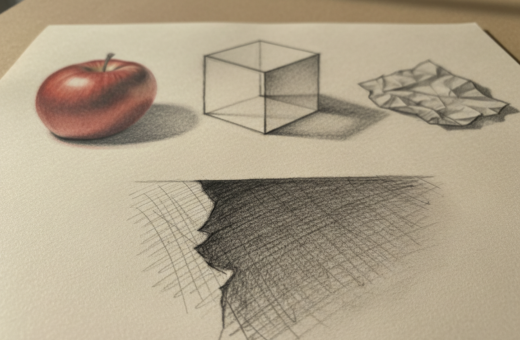
Start with a 9–12 cm rectangular template to build a full value scale. Fill the shape with vertical hatches first. This establishes an even base for tone.
Creating Uniform Hatching Patterns
Keep spacing consistent. Work slowly and aim to place new strokes between existing ones so the pattern reads as a single surface.
Developing Value Scales
After the vertical layer, add inclined strokes, then horizontal ones. Each pass deepens the value and adds grain and texture.
Precision Placement Techniques
Place marks deliberately. Aim for uniform direction and steady pace so the marks look like a cohesive system rather than many messy parts.
- Use the template to repeat the same process several times.
- Vary hatch density to move from light to dark smoothly.
- Artists use this step to define forms and add volume.
“Small, ordered practice turns tiny marks into believable shading.”
Exploring Wavy and Zigzag Line Patterns
Wavy and zigzag patterns train your sense of rhythm while keeping practice playful.
Try an easy exercise that fills a border with alternating curves and angles. Work slowly at first, then add pace to test timing.
In the included video, the demo shows how to outline a shape and fill it with patterned marks.
These exercises are not about perfect output; they are about finding a comfortable flow in your hand movement.
- Draw within set borders to check if your rhythm holds steady.
- Vary pressure to see how different strokes behave with your pen.
- Repeat short runs to loosen up and build a more expressive style.
“Enjoy the process; steady, playful repetition will make your marks more deliberate and alive.”
Using Ghosting Techniques to Improve Confidence
A quick pre-trace in the air can make your next stroke feel certain and clean.
Ghosting means tracing a path above the page before your pen meets paper. This simple exercise trains the mind to visualize the exact lines you want.
Spend a few minutes each day to ghost shapes and straight runs. The practice helps your hand learn the motion without fear of making a permanent mark.
Try tracing over marks you already made and then place your pen on the same path. This test shows how accurately you can match a path and improves overall quality and accuracy.
- Air-trace the motion first to steady pace and pressure.
- Visualize the result so your mind and hand work together.
- Practice short bursts to build rhythm and enter a reliable flow.
“Ghosting gives your muscles a rehearsal — fewer doubts, smoother marks.”
Incorporating Circles and Ellipses into Your Routine
Working with circles and ovals each day builds the hand confidence needed for three-dimensional forms. Spend a few minutes practicing simple rounds to see how they sit on the page and how light shapes them.
Use a cylinder as a live reference. Rotate a glass or jar and watch how the circular end turns into an ellipse. This visual shift is a fast lesson in perspective that you can apply when sketching objects from life.
Using Cylindrical Objects for Reference
Try this: place two straight lines as boundaries and draw circles and ellipses between them. That frame forces accuracy and helps the shapes meet the edges cleanly.
- Include circles and ellipses in short daily practice to improve how you construct cylinder-like forms.
- Watch the video to see a demo of a rotating object and how caps become ellipses when turned.
- For speed and focus, draw these shapes directly in pen to commit to each mark and sharpen accuracy.
These drawing exercises also make you notice how light and viewpoint change a round form. Over time, placing circles correctly on your paper becomes one of the most useful things for building believable, three-dimensional work.
Conclusion
Finish your session by pausing to note one small improvement you made today.
This article showed clear steps to build steady marks and practical skills for better art. Regular, focused work with a reliable pen trains muscle memory and boosts confidence.
Every artist starts somewhere. Take one simple step each day, accept happy accidents, and let them shape your style and creativity.
Join our community of over 36,000 subscribers to get new lessons and tips. Keep your pen moving, stay curious, and enjoy the steady progress of practice.