Anúncios
Quick, focused practice helps you build control and confidence without needing hours each day. This guide defines daily sketching exercises as small, repeatable drills and observation studies that target fundamentals through steady repetition.
Expect a step-by-step system you can run in minutes and scale when you have more time. The plan keeps improvement realistic for a busy schedule and sets a clear goal for measurable progress.
You will see present-tense gains in line quality, shapes, shading, and decision-making while you draw. The article lays out warm-ups, line-control drills, circles and ellipses, shading strokes, texture work, home observation tasks, still-life lighting shifts, perception resets, and short, time-boxed routines.
Better practice focuses on intentional repetition, quick feedback, and simple tracking so progress stays steady, not perfect. Even short sessions translate into steadier lines, cleaner forms, and faster problem-spotting in your art.
This guide emphasizes consistency and momentum so you keep going every day, even when motivation slips.
Anúncios
Why daily practice works for improving drawing skills
Small bursts of focused work train your hand to respond to what your eye actually sees.
Repetition is the mother of skill. Repeating lines, basic shapes, and common strokes makes them automatic. When mark-making becomes internalized, your attention frees up for proportion, composition, and design choices.
Muscle memory links eye and hand like learning chords on a guitar. Repeated marks build steadiness so your hand does what your eye intends. This trains control and reduces guesswork.
Anúncios
Short sessions keep you in shape
You don’t need long blocks to improve. Even two-minute micro-sessions prevent the drop-off that follows long breaks.
Splitting time into small blocks—two, five, or ten minutes—protects consistency on a busy day and sustains momentum.
Balance enjoyment and effort with the 70/30 mindset
Adopt a 70/30 approach: most sessions focus on joy and free play, while 30% includes focused drills and timers. That mix keeps the habit pleasant and productive.
The mind resists at first; structured drills calm that friction and help you settle into flow. Over weeks, small commitments compound into visible improvement.
| Focus | Length | Benefit |
|---|---|---|
| Line control | 2–5 minutes | Builds steadiness and speed |
| Shape work | 5–10 minutes | Improves proportion and form |
| Play | 10–15 minutes | Boosts creativity and motivation |
What you need to start a daily sketching habit in minutes
A quick, low-friction kit and short timers make it easy to begin practicing right away.
Keep materials simple: a pen or pencil, loose paper or a sketchbook, and a flat surface. These three items cut setup time so you can begin within minutes.
Choose a dedicated page
Pick one page (or a few pages) for drills. That reduces decision time and gathers progress in one place.
When you flip back weeks later, the changes are clear across pages.
Pencil vs. pen
Use pencil for soft starts and value checks. It lets you ease into form and tone.
Use pen to force accuracy. Pen prevents over-erasing and gives honest self-feedback when a line wobbles.
Timing and tools
Try two-minute blocks for tight schedules and a repeatable 15-minute routine when you have more time.
Use a phone timer, a simple timing app, or mini sand timers so your technique training stays time-boxed and consistent.
| Need | Why it helps | Quick setup |
|---|---|---|
| Pen or pencil | Reduces friction; supports different studies | Ready in seconds |
| Loose paper or sketchbook | Keeps drills together for review | Flip back to track progress |
| Timer | Supports focus and repeatable routine | Phone app or sand timer |
How to warm up your hand for better line quality
Begin with simple marks that free your hand and clear your mind for focused work.
Why warm-ups matter: short drills reduce stiffness, improve line placement, and shift you from self-critique into focused mark-making before a real drawing.
Resistance vs. flow: a simple readiness test
Start your warm-up and watch how your mind reacts. If you feel impatience, overthinking, or rushing, that is resistance.
Keep going until the marks become easier and you enjoy the motion. That feeling of ease shows you are in flow and ready to move on.
Core cues that improve lines immediately
- Slow down — steady speed gives control and cleaner edges.
- Light touch — less pressure cuts wobble and keeps forms honest.
- Look ahead of the tip — guide the stroke by aiming where the line will go next.
Adapt warm-up length to your schedule: a single minute can help, or spend a few minutes when you have more time. Treat the warm-up as a preflight check that protects accuracy and confidence across the rest of your session.
Daily sketching exercises for line control and accuracy
Precise line work begins with small, repeatable drills that force your hand to aim where your eye intends.
Aim lines toward points
How it works: place a small circle with a white dot as your target. Draw single strokes toward that dot from different angles.
Do not rotate the page. This builds real-world control for common drawing positions.
Parallel lines for spacing and steadiness
Draw several lines side by side, keeping the gap consistent. The human eye sees spacing errors immediately.
This method forces you to correct direction and pressure on the spot.
Draw to an end line
Set two boundaries and start exactly on one, ending exactly on the other. This trains clean starts and stops.
Use pen to prevent erasing; mistakes stay visible and teach faster.
Ghosting to build single-stroke confidence
Rehearse the motion above the page, then make one committed stroke. Ghosting reduces scratchy searching and improves control.
Spotting mistakes with self-referential drills
These drills show errors instantly, so you can fix the way you move your hand without complex feedback.
Practical rule: aim for one good line at a time, use a light touch, and slow down until accuracy improves. Then increase speed.
| Drill | Focus | Tool |
|---|---|---|
| Aim to point | Intentional stroke placement | Pen, small circle target |
| Parallel lines | Spacing & direction control | Pen or pencil |
| Draw to end line | Clean starts/stops | Pen recommended |
| Ghosting | Single-stroke confidence | Pen for execution |
Circles, ellipses, and spirals to build clean forms
Circles and ellipses are the quiet building blocks behind most three-dimensional forms you draw. They appear in cylinders, wheels, cups, joints, and construction elements, so cleaner round shapes improve overall drawing skills quickly.
Controlled repeats: size, speed, and direction
Fill a page zone with circles and ellipses at varying sizes. Repeat the set slowly, then repeat faster to see where control breaks down.
Draw both clockwise and counterclockwise to avoid one-sided habits and strengthen motion in both directions.
Precision drill: touching ellipses
Draw two parallel guide lines. Place ellipses so each one touches both guides and its neighbors. Errors become obvious and fixable.
Ellipse in space and spiral warm-up
Use a cup or glass as an example: rotate it and watch the rim change from near circle to narrow ellipse. Observe and redraw the rim at each angle.
Start with spirals to train continuous motion—this makes ellipses smoother and less lumpy. Progress from large to small; aim for symmetry first, then add speed.
Daily stroke drills that make shading and rendering easier
Stroke drills turn raw line control into a reliable toolkit for believable shading. Think of marks as building blocks: when they become automatic, rendering feels easier and faster.
Core stroke families
Practice these regularly: hatching, cross-hatching, stippling, scribbling, and contour strokes. Each produces distinct texture and value effects that you can mix.
Timing and variation
Do one stroke for two minutes, then switch for another two minutes. This focused minute-by-minute approach keeps the drill short and repeatable.
- Vary pressure to change value.
- Shift spacing to control density.
- Change direction to follow form and avoid flatness.
Combining strokes
Layer two strokes — for example, light hatching plus stippling — to create richer surfaces. Treat combinations as your artist vocabulary; pairing marks expands what you can describe on paper.
| Stroke | Primary use | Effect on value |
|---|---|---|
| Hatching | Builds smooth gradients | Even, directional tones |
| Cross-hatching | Deepens shadow areas | Dense, textured darks |
| Stippling | Fine texture and soft edges | Controlled dot density |
| Scribbling | Loose texture and energy | Varied, organic tones |
| Contour strokes | Wraps form for volume | Defines edges and planes |
Mastering these simple drills improves overall skills and helps artists choose marks with confidence. Use this short routine as a steady bridge from lines and shapes to convincing renderings in your art.
Texture practice that builds realism fast
Texture practice trains your eye to read surfaces and your hand to reproduce them quickly. Small, repeatable mark studies build a personal library of strokes you can apply when rendering wood, fabric, metal, or stone.
Core setup: on one page, draw a grid of ~1-inch squares. Treat each square as a mini study of a different material and tone. This shows rough spots and uneven density right away.
Fill the grid with materials
Try these idea prompts for each cell:
- towel fabric
- pillowcase weave
- cardboard edge
- painted wall stipple
- worn leather
- wood grain
Gradient rectangles
Create long rectangles and use one texture method across each. Move from dark to light by changing spacing and pressure. This single-exercise trains value control without swapping tools.
Wrap textures around form
Apply a chosen texture to a cylinder, box, and sphere so marks follow curvature. That makes the surface read as volume instead of a flat pattern.
Quick feedback: the grid reveals gaps and direction issues instantly, so you correct strokes faster. Rotate textures across your pages through the week to build a ready reference you can flip to before larger pieces. For more on realism techniques, see techniques for achieving realism.
Observation-based drawing exercises you can do at home every day
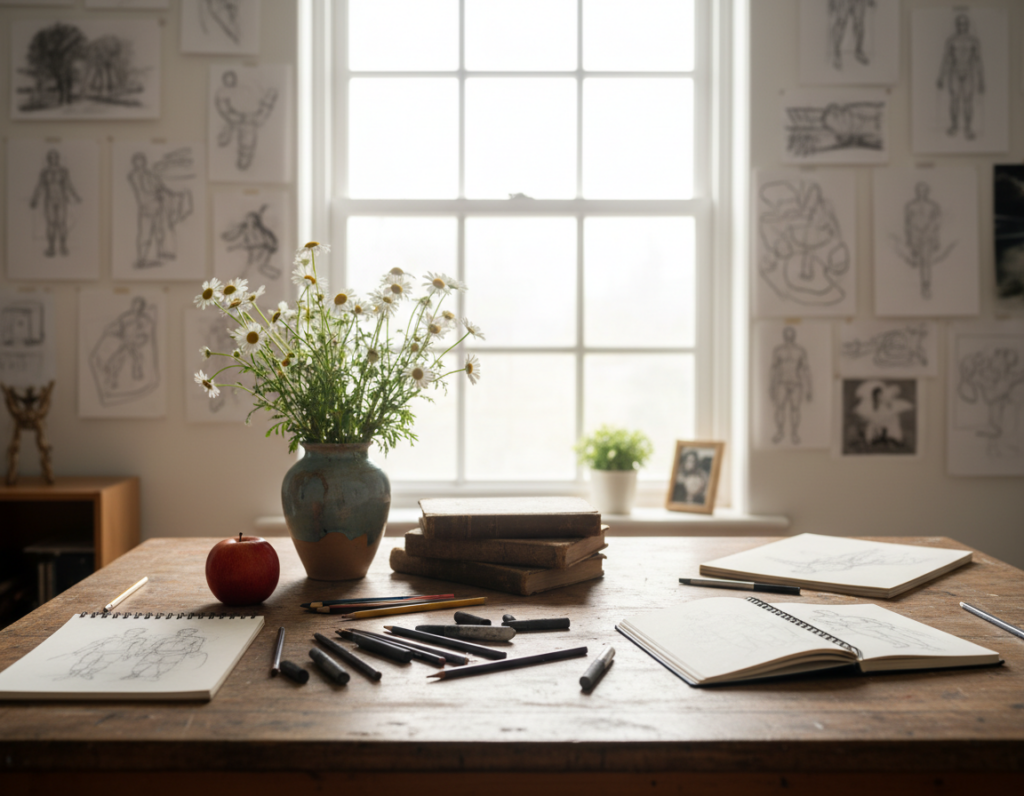
Use simple household items to sharpen what your eye notices and how your hand responds. These studies act as a real-world test: you apply line control, shapes, and stroke habits to an object under true light.
Pillow studies for folds, edges, and quick shading
Sketch the pillow’s outer contour first. Add a few fold edges and block in main shadow shapes. This fast shading lab trains readable form without overworking details.
Crumpled paper for contour, value, and complex planes
Focus on sharp planes and changing edges. Group tones into lights, mids, and darks to simplify complexity. The exercise teaches you to reduce chaos into clear planes.
Your off hand for life drawing practice and small movements
Break the hand into simple masses. Accept subtle motion and draw short gestures. This method makes life drawing approachable and improves control of small marks.
Your feet for foreshortening and simplifying shapes
Start with big masses for the foot, then place toe and ankle landmarks. Working from large to small trains proportion under hard angles.
| Study | Focus | Quick benefit |
|---|---|---|
| Pillow | Folds & shadow shapes | Readable form and fast shading |
| Crumpled paper | Planes & contours | Simplify complex value |
| Off hand | Gesture & small movements | Life drawing confidence |
| Feet | Foreshortening & mass | Proportion under angle |
Rotate subjects each session. The same thing seen from new angles gives endless variety without setup cost. Over time, these observation drills turn abstract practice into clear skills you can use in real drawings.
Still life variations that train light, shadow, and composition
A still life lets you control every variable so you can focus on how light and shadow behave. It becomes a testing ground: you choose the object selection, the light, and the framing. That control makes progress measurable and repeatable.
Single-lamp setup for clear shadow shapes
Use one lamp, a corner to catch reflected light, and 1–5 simple, non-reflective objects. Keep the background plain so cast shadows and halftones read clearly.
Why this works: a single source simplifies shadow logic and reveals how edges change with angle.
All-white or all-black value drills
Try an all-white or all-black arrangement of the same objects. This forces you to see subtle value shifts rather than relying on color or labels.
Change the light and redraw
Draw the setup, then move the lamp and redraw from the same viewpoint. Repeat this to learn how light direction alters core planes and cast shadows.
“Short, repeated runs let you test hypotheses about light without wasting time.”
- Start short: one 10–15 minute pass, then extend as skill and confidence grow.
- Use spacing and overlap to study composition and how shadows support design.
- Translate cleaner shadow logic to portraits, interiors, and product drawing for a higher level of finished work.
Perception resets to stop drawing what you “think” you see
Perception resets are quick methods that interrupt symbol drawing and force direct observation. These short tactics break the habit of drawing familiar icons and push you to copy actual lines, angles, and values.
Unusual angles change viewpoint so the brain can’t rely on memory. Turn an item on its side or draw it from above. This makes familiar forms read as new shapes and exposes mistakes in proportion and placement.
Zoom-in studies crop a small area—an edge, an intersection, or a texture—and treat it as an abstract design problem. This idea trains your eye to see subtle contours and value shifts instead of the object as a whole.
Upside-down copying
Flip a reference and copy what you see. Upside-down drawing removes labels and forces relationship-based seeing. It’s an effective way to retrain proportion and alignment without analysis.
Negative space work
Draw the empty areas around your subject as a part of composition practice. Negative space studies make placement and spacing far more reliable and improve overall composition.
| Reset | Focus | Quick benefit |
|---|---|---|
| Unusual angles | Fresh shapes | Fixes proportion errors |
| Zoom-in studies | Edges & intersections | Sharpens local detail |
| Upside-down | Relationships | Reduces symbol drawing |
| Negative space | Composition | Improves placement |
Use one reset whenever you feel stuck. Treat it as part of your process, not a separate project. These methods lead to measurable accuracy gains and faster development of drawing skill.
Time-boxed routines for busy days
A compact, repeatable plan transforms a spare fifteen minutes into clear gains. Use a timer or sand timer so the routine stays predictable and easy to start.
A 15-minute routine you can repeat every day
Follow this exact breakdown to remove decision fatigue:
- 2 minutes — stroke practice #1
- 2 minutes — stroke practice #2
- 1 minute — combine strokes
- 2 minutes — focused shape work
- 2 minutes — texture study
- 2 minutes — pillow observation (value blocks)
- 4 minutes — quick sketches
Use a visible timer. When it rings, stop and move on. That limit protects consistency and prevents sessions from stretching into whatever time you have.
The five-minute burn to train instinct and speed
Start immediately and draw whatever sits in front of you. Prioritize big shapes and massing values. Avoid details; capture information fast.
Quick sketches for energy, confidence, and visual memory
Quick sketches favor speed over accuracy. Choose moving subjects — people on TV, pets, or street scenes — to force decisive marks. These short runs keep momentum when you can’t do longer practice.
“Short, predictable runs beat unpredictable long sessions for building habit and skill.”
How to track progress and level up your sketchbook pages over time
A simple tracking plan makes progress obvious. Treat your sketchbook as data: track a few metrics each week so you can compare results and adjust the next week.
Setting a weekly goal: pages, minutes, or a single skill
Choose one clear goal that fits real life: a number of pages, total minutes, or one skill to sharpen (ellipses, value control, etc.).
Rotate focus to avoid plateaus
Make a weekly plan: line day, ellipse day, texture day. Rotation keeps consistency while targeting weak spots.
Advanced mode: practice drills inside real work
After a few weeks, add ghosting, aiming, and slow, deliberate starts into actual drawing sessions. This helps drills become part of the process, not a separate thing.
Common mistakes and a quick review habit
Avoid rushing, over-erasing with a pencil, and unfocused sessions. Once a week flip back two similar pages, note one thing that improved and one adjustment to try next.
| Target | Sample weekly | Why it helps |
|---|---|---|
| Pages | 3–6 pages | Visible volume and variety |
| Minutes | 75–150 minutes | Consistent time investment |
| Skill | One focused skill | Faster leveling of weak areas |
Conclusion
A few intentional minutes of work add up and protect the skills you care about. Small, repeatable exercises compound into steadier lines, sharper observation, and more confidence even when your day is busy.
Warm up your hand, run two or three targeted drills, then apply those marks to a short object study or quick drawing. That loop—warm-up → drill → real subject—moves technique into usable skill.
Give special attention to circles and ellipses. Cleaner rounds improve construction across cups, heads, and joints. Practicing these shapes yields big returns for little time.
Your mind may resist at first. Brief, disciplined warm-ups usually shift you into a calmer, more focused process that feels better and lasts longer.
Try the routines exactly as written for one week. Start with minutes-based goals, then move to pages, and finally fold drills into finished work as an advanced mode.
Now pick today’s exercise, set a timer, and start on the next page. Slow down, use a light touch, and look ahead as you draw so each minute counts.