Anúncios
This guide shows how a repeatable routine—centered on life drawing practice trains the eye and builds reliable skills. The goal is not just to make pleasing marks. It is to sharpen proportion judgment, see form in three dimensions, and make clearer construction choices under time limits.
This short how-to walks you through a present-tense process you can use in a studio, classroom, or at home with a model or mirror. You will learn what to measure now, what to prioritize, and what to leave for later.
Expect outcomes: stronger proportion reading, cleaner structure, and faster decision-making. The approach treats the work as both artistic and meditative: steady looking trains focus and deepens observation.
This material suits beginners who need structure and intermediate artists who want fewer distortions and more dependable results. The guide covers setup, materials that control outcomes, proportion checks, gesture plus structure, smart class use, and anatomy that supports observation.
What Life Drawing Is and Why It Improves Artistic Perception
Observation is the core skill: sitting with a live model trains the eye to see relationships, not symbols. This kind of drawing is about accurate seeing. The goal is perception, not stylish mark-making.
Anúncios
Observation over invention
“Take your time and look at the model… Even on a short pose… spend most of the time looking.”
When you stop looking you fall back on memory symbols and errors grow. Ask simple questions before each mark: What can I see? How does this line up? How much space sits between forms?
Seeing the figure as volume
Avoid outline-first habits that make a figure look like a flat cut-out. Read ribcage, pelvis, and limb volumes instead of tracing a contour.
Anúncios
Transfer beyond the studio
Training perception with a model boosts portrait work, still life, and urban sketching. Study strong drawings by other artists to learn how experienced hands simplify forms while keeping accuracy.
Next: combine rigorous looking with a method for placement, proportion checks, and iterative correction. For a quick primer, see three reasons to practice life drawing.
Setting Up a Productive Life Drawing Session
Start by arranging the room so your choices reduce guessing and highlight structure. Pick a view with a clear silhouette and minimal overlaps. Stand or angle your stool so the model’s limbs do not mask one another.
Choosing your view and distance to reduce distortion
Follow a simple rule of thumb: if you are closer than about six times the model’s height, expect perspective effects.
When you are that close, accept that the head and feet sit at different visual points. Adjust your stance, bend, or step back rather than copying camera-like distortion.
Working standing up and stepping back to judge proportion
Work standing when possible. Moving back lets you judge relationships across the whole figure.
Spend the first few minutes setting view, paper angle, and composition. A strong start saves far more time than late fixes.
Lighting choices: making light and dark describe form
One clear light source helps you read planes. Use light and shadow to mark volumes, not to decorate a mistaken outline.
Example: a single lamp at a 45-degree angle casts shadow shapes that reveal the ribcage and pelvis.
“Your position affects the outcome; choose a good, clear view and step back often.”
- Pick a viewing point with a readable silhouette and little overlap.
- Manage distance: under ~6× model height, plan for perspective changes.
- Control the session: you may not set pose time, but you can choose where to stand, when to step back, and how to use light.
Materials That Build Control and Clean Lines
Your tools shape vision; select gear that makes mistakes visible so you can fix them. Choosing the right setup helps you train proportion and measurement instead of masking errors.
Why disciplined graphite supports precision
Vladimir London recommends a well-sharpened 2B and several pencils pre-sharpened to save time. A sharp graphite point yields crisp marks that reveal small alignment errors.
Control-first kit: sharpened graphite (2B), kneaded eraser, hard eraser, and a simple board. These let your lines stay intentional and readable.
When charcoal or ink make sense
Charcoal covers large areas fast and allows broad adjustments, as Paul notes. Use it for massing values once structure is secure.
Ink or dip pen forces commitment. It can sharpen decision-making for advanced users but will punish early-stage proportion searching on long studies.
Choosing paper and scale by time
Small paper suits short poses: you finish more gesture and proportion exercises per session. Larger sheets support longer studies where room for construction matters.
- Materials choice is a technique: pick tools to train the skill you want today.
- Intentional constraints beat rendering without a plan in timed sessions.
For focused line work, try a few targeted line quality exercises to build steady skills.
Life Drawing Practice for Better Proportions and Figure Accuracy
Begin each study by mapping the full figure envelope before any detail work. Analyze the pose, then lightly block in height, width, and the centerline. Pause and step back to confirm the whole fits the page.
Start with composition placement before details
Place the major axis and the big silhouette first. This prevents chasing features that sit off-center or too high.
Using the head as a measuring unit and checking key landmarks
Use the head as a measuring unit—most adults measure about 7.5–8 heads tall. Mark the head units and check obvious landmarks: elbow to ribcage, pelvis level, and knee breaks.
Alignments and negative spaces: comparing one part to another
Compare vertical and horizontal alignments: wrist vs. crotch, knee vs. elbow. Use the spaces between limbs as a measuring tool to validate angles and spacing.
Marking and re-checking proportion points as you draw
Lightly place proportion points and re-check them often. Treat marks as questions, not final lines. Iterative checking cements internal calibration so future figure drawing decisions are faster and more accurate.
“Draw what you know” — use measured marks to make accurate choices.
- Start big: envelope, centerline, balance.
- Measure: head units and landmark checks.
- Repeat: mark, step back, correct.
Gesture and Structure: A Simple Process You Can Repeat Every Time
Start each study with a clear plan: look first, place a single gesture line, then build simple forms. This repeatable process saves time and keeps decisions honest.
Spend more time looking than marking
Pause often. Ask alignment questions before you commit a new line. Paul advises: take your time and look again; even short poses need more seeing than hasty marks.
Draw from the center outward
Begin by blocking the torso mass, then attach the shoulder and limb placements. This center-out strategy makes the figure read as connected volume rather than a flat contour.
From gesture to basic forms
Use a loose gesture to capture rhythm, then simplify the ribcage and pelvis into basic forms. Place the shoulder block and major tilts before chasing edges.
Delay tonal work and allow correction
Rule: hold off on shading until proportions and construction hold. Vladimir London warns that tonal rendering can mask structural problems—don’t paint a collapsing house.
“Do not be afraid to erase and redraw as many times as required; class drawings are exercises.”
- Repeatable workflow: look → gesture → block-in forms → refine proportions → tone (if solid).
- Practical outcome: this method works in both 2-minute and 40-minute sessions because priorities stay the same.
How to Get the Most Out of Figure Drawing Classes When Timing Isn’t Ideal
When class moves quickly, set one clear objective so every short sketch trains a specific skill.
Ultra-short poses (2–5 minutes) often feel like wasted time for a new student. Without a plan you end up repeating the same proportion errors. Be honest: speed alone doesn’t build accuracy.
Reframe short poses as targeted exercises. Pick one aim—gesture rhythm, a single alignment, or a landmark—and ignore finish. This narrows focus and creates useful feedback.
Work small. Fill a sheet with tiny sketches so you get many repetitions. Vladimir London advises compact gestures over sprawling attempts on A3 in ten minutes.
Do micro-studies instead of full-figure sprints. Isolate a hand, the head tilt, a torso bend, or a tricky foreshortening. Treat each as a deliberate drill and note what improves.
“Create a thirty-lesson plan: study at home, bring focused anatomy sketches, and measure progress against yourself.”
| Session Type | Goal | Duration | Outcome |
|---|---|---|---|
| Mini gestures | Rhythm & flow | 2–5 min each | More reps, faster correction |
| Micro-study | Hand, head, or torso | 5–10 min | Focused skill gain |
| Weekly plan | Rotate weak areas | 30 lessons | Measurable progress over years |
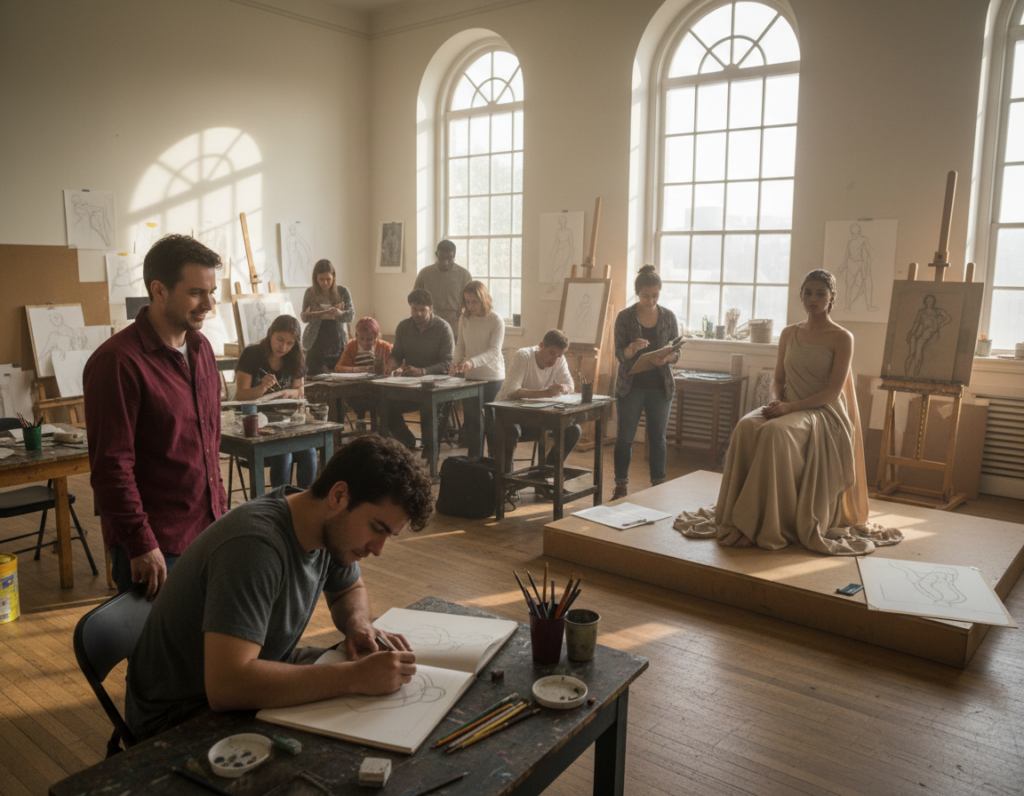
Start learning with sensible goals. Prioritize construction over finish; speed will follow as habits become automatic. This idea helps a student stay steady and improve across weeks.
Anatomy and the “Draw What You Know” Approach
A working knowledge of anatomy lets observation stay honest when perspective tricks your eye. Use structural facts as a quick check when the view looks unfamiliar.
Balancing observation with anatomical checks
Observe the model first. Then use known landmarks to test what you saw.
Example: count head-units (about 7.5–8 heads tall) and note the elbow near the ribcage end. These facts correct perspective errors without killing momentum.
Study parts separately
Spend short sessions on hands, feet, and facial structure at home. Isolating complex parts speeds class progress and builds confidence.
Overlay exercises to test structure
Draw the figure, then sketch a simplified skull or skeleton beside it from the same view. Mark joint centers and major muscle masses.
This exercise reveals misplacements quickly and trains you to place bones before details.
Learn from artists without copying
Study historic and contemporary artists to extract clear construction choices. Keep observation first; use references to expand your toolbox, not to mimic style.
“Draw what you know instead of what you see.” — Vladimir London
Conclusion
strong, A steady routine of looking, measuring, and correcting yields faster gains than chasing finish. Commit to a clear process: place the composition, check proportions, build structural forms, then add tone only when the foundation holds.
Use short sessions to train specific skills. Spend most of your time observing alignments, testing marks, and revising lines. Choose controlled materials, work at a sensible scale on your paper, and set one objective per session.
Track weak areas with targeted exercises and basic anatomy study. Over months, these small steps compound into reliable perception and stronger figure work. Enjoy the work—experiment, erase, and keep learning.