Anúncios
The Morning Sketches APP offers a clear roadmap for daily warm-ups that save time and boost skills. It guides an artist through short, focused sessions that build hand control and mark-making confidence.
With just a pen, pencil, and paper, anyone can start. Practicing 15 to 25 minutes per session helps form muscle memory. Small drills on lines, circles, and basic shapes make complex perspective and textures easier.
This post shows a simple way to use a video-based course and a sketchbook to fill pages with purposeful work. Artists learn to render light, space, and values while tracing a clear path from warm-up to finished drawings.
In short: focused, daily practice on a blank page turns a bit of time into real progress. The method is practical, repeatable, and used by many professional artists to keep their skills sharp.
Anúncios
The Importance of Consistent Practice
Short, regular sessions are the engine behind steady artistic growth. A clear routine helps the hands and eyes remember key movements. This builds muscle memory the same way scales help a musician play with ease.
The 70/30 rule keeps practice sustainable: 70% of time goes to joyful projects and 30% to focused drills. That small, steady commitment makes the creative time more productive and less stressful.
Establishing a pattern matters. Repeating specific drawing exercises for a few minutes daily helps lock in form, line weight, and control. Over time, those small repeats lead to faster progress on larger pieces.
Anúncios
- Set short daily sessions to reinforce core skills.
- Use the 30% of disciplined work to support 70% creative play.
- Treat drills like musical scales—deliberate and focused.
- Commit to daily practice so hands and eyes stay coordinated.
Essential Beginner Drawing Exercises for Skill Development
A short set of focused drills rewires the hand so lines arrive where the eye wants them. These sessions build muscle memory, improve control, and make complex subjects feel manageable. Ten to twenty minutes a day creates a meditative flow that drowns out the inner critic.
The Role of Muscle Memory
Muscle memory forms when the hand repeats precise marks. Peter Han’s Dynamic Sketching course stresses drawing circles and ellipses between lines to improve precision.
Practice this way:
- Start with straight lines, then add controlled circles.
- Repeat until the hand places each point with intent.
- Gradually introduce basic shapes and simple perspective.
Overcoming the Inner Critic
The inner critic often acts like a “blabbermouth” that interrupts progress. One effective counter is to treat the session as meditative work.
“Focus on mark-making for 10 to 20 minutes; the voice quiets and the hand learns.”
Benefits: these short, structured sessions help render light and values on an object, translate textures, and move from simple lines to complete drawings with purpose.
Mastering Line Quality and Control
Line quality starts when the eye plans a mark and the hand follows with calm control. This section shows a simple, repeatable way to train the arm, shoulder, and wrist so lines arrive where intended.
Targeting Points with Intent
Place a small white dot on the paper and draw straight lines that end exactly on that point. This focused exercise forces the artist to aim without rotating the page. Using a pen makes each mark permanent and builds careful habits.
- Slow the motion: slow strokes improve line quality and teach intent.
- Look ahead: guide the pen by watching where the line will be a second later.
- Daily minutes: spend a few minutes each day to train muscle memory.
- Use a pen: no erasing means more deliberate pressure on the page.
- Vary angles: move the hand from the elbow and shoulder to gain control.
Watching a short video of this drawing exercise helps refine a light touch, similar to how pros ink work. Over time, one line at a time creates the space to see errors and correct them.
Developing Precision with Shapes and Forms
Training simple shapes teaches the hand how to build complex forms from small, steady parts. This approach relies on clean, repeated marks to train muscle memory and visual judgment.
Watts Atelier recommends warm-ups that focus on circles and ellipses to tune internal symmetry. Using a pen makes each mark final, which forces attention to where the line begins and ends.
Observe cylindrical objects like a glass to see how a circular rim becomes an ellipse when tilted. That change helps the artist translate three-dimensional objects onto flat paper.
- Practice circles and ellipses in both clockwise and counter-clockwise motions.
- Work small sets of shapes to check where each line or point lands.
- Use course drills that push the hand toward fluid, consistent arcs.
“By focusing on the symmetry of circles, the foundation for more complex forms becomes automatic.”
Consistent practice with basic shapes lets beginners integrate these forms into finished work without overthinking the process. Over time, simple shape drills speed up accuracy and confidence on paper.
Understanding Perspective Through Simple Drills
A few focused perspective drills can turn flat pages into believable space. Perspective practice helps avoid the common errors that muddy man-made objects like vehicles and buildings.
Start with short sessions of a few minutes. Use a pen and draw straight lines toward a vanishing point. This trains the eye to place objects and shapes correctly on the page.
The course outlines an easy path: begin with 2-point perspective, then move to 3- and 4-point setups, and try a fisheye view as skill grows.
- Why it matters: perspective creates instant space around any subject.
- Repeat drills on a fresh page to improve spatial visualization.
- Use deliberate lines to keep scale and placement consistent.
“Spend a few minutes each day on simple perspective work to prevent errors that ruin a finished piece.”
These short, structured exercises let beginners build control and confidence. Over time, objects feel anchored in a convincing three-dimensional world.
Building an Artist Vocabulary with Textures
Learning textures turns simple marks into a useful visual language. Practicing a range of marks helps an artist show surface, light, and values with confidence. Small, focused work in a sketchbook builds that visual vocabulary over time.
Creating Tonal Grids
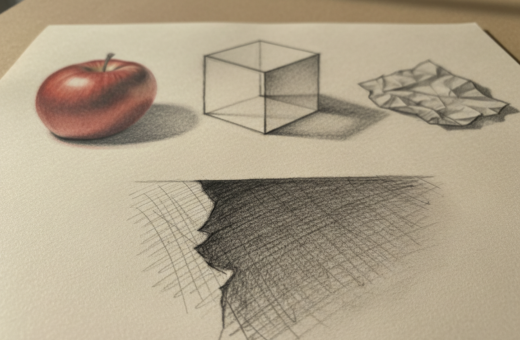
A tonal grid of one-inch squares on a page is a practical way to test marks. Fill each square with a different texture: stippling, hatching, scribbling, or tight cross-hatch. This lets the hand learn transitions from light to dark while using only a pen.
Try this: spend a few minutes a day on one grid. Track how lines and dots change value across the pages.
Wrapping Textures Around Forms
Next, wrap those textures around simple shapes—sphere, cylinder, and box. Doing so teaches how textures follow surface and how light affects tone across space. It also helps integrate lines and patterns into finished work.
- Practice stippling for smooth fades.
- Use directional hatching to imply form and plane.
- Vary pressure and stroke to expand the artist’s toolkit.
“Master each stroke so it appears naturally when needed.”
Utilizing Ghosting Techniques for Accuracy
A simple rehearsal above the page can turn shaky marks into single, confident lines.
Ghosting is the act of tracing a stroke in the air before the pen meets the paper. This lets the hand rehearse the motion until the eye and hand agree on the end point.
Use ghosting as a short, daily exercise. Spend a few minutes with a pencil or pen and float the motion above the sheet. Then commit the stroke once, aiming to place the line with one fluent motion.
- It helps build muscle memory so lines land where intended.
- Practice on simple shapes or a real object to train spatial judgment.
- Watch a short video to learn how to look ahead of the pen point.
- Repeat for a few minutes each session to gain steady control.
“Rehearse the motion in the air until the stroke feels natural, then draw with purpose.”
Over time, ghosting shortens the time spent correcting marks and improves accuracy in finished work. It is an essential drawing exercise for anyone who wants cleaner lines and better placement on the paper.
Advanced Methods for Integrating Drills into Finished Art
Advanced practice folds routine drills into real projects so each mark improves the final piece. This approach turns rehearsal into production, letting artists refine skills without adding extra time to the schedule.
Integrating drills into a workflow means using inking passes and texture fills as purposeful practice. Every line can train the hand and improve control while the illustration grows.
Dexterity Training During Illustration
Dexterity exercises work well during inking. While filling a region, the artist repeats precise arm motions that build steadiness.
This lets practice happen in minutes that would otherwise be idle. Professional artists use these moments to keep their hands in shape.
Practicing Cross-Hatching
Cross-hatching applies parallel lines to model light and shadow on a subject. It is a practical way to use texture drills directly in a piece.
Consciously vary line weight and spacing to translate textures and values learned in earlier work into finished drawings.
Refining Proportions
Use reference ideas from the course and short video demonstrations to check proportions as you work. Small, frequent checks keep scale and perspective accurate.
“Every mark on the page is an opportunity to practice and improve.”
- Integrate drills into production to refine skills without extra time.
- Practice line-to-point and cross-hatch while inking to maintain dexterity.
- Apply textures and values from warm-ups to render light on the final subject.
Managing Your Time for Maximum Growth
Use tiny timers or a phone app to mark focused 15-minute sessions. They turn scattered minutes into a reliable part of the week.
Practice while waiting for a kettle to boil or between other tasks. This course recommends rotating warm-ups so each session feels fresh and useful.
- Make practice non-negotiable by booking it into the daily schedule.
- Rotate through warm-ups to challenge lines, form, and control.
- Track short sessions to see steady improvement in line quality and speed.
- Use brief sessions rather than rare long stints that lack clear goals.
“Consistent, bite-sized work beats occasional, unfocused marathons.”
In this post, the best way to grow is simple: protect small chunks of time, vary the exercise, and enjoy the process. That steady work builds skill without overwhelming a busy day.
Conclusion
Small, steady steps make complex skills feel achievable over time. Applying a set of beginner drawing exercises and focused practice improves hand-eye timing and overall skills. This approach keeps progress steady without overwhelming the schedule.
These methods build muscle memory and confidence so each drawing feels easier to finish. The repeated routines train one specific skill at a time, and the results show in cleaner lines and stronger drawings.
When exercises help the process, artists of all levels see gains in how they plan and render art. Keep one short exercise per session, and beginners should track progress to grow their drawing skills. Stay patient, enjoy the work, and let each page move the practice forward.