Anúncios
Still life sketching teaches observation, proportion, value, and form using common, movable objects. A still life is a work of art showing mostly inanimate subjects that reveal texture, reflection, and shape.
Drawing from what sits in front of you speeds learning more than copying photos. Direct observation helps with depth, real light, and consistent perspective.
In this guide you will learn how to choose objects, control one light source, build a composition, block in shapes, and render light and shadow. The aim is clean, believable work, not perfect realism.
One page, one light, simple setup makes practice repeatable at home or in a busy classroom. Over time, short studies become steady progress in your drawing skills.
We reference artists like Morandi, Cézanne, and van Gogh as inspiration for composition and study habits, using their works as examples without copying finished pieces.
Anúncios
Gather the Right Tools and Drawing Surface for Clean Still Life Drawings
Start with a clean, reliable surface and a few graphite grades to control tone and texture. Choosing the right paper affects value range, smudging, and how crisp your final drawings look.
Choosing paper that supports a full range of values
Use a medium-weight, toothy sheet that holds both light marks and deep layers. Smooth papers suit fine detail; textured papers hold more graphite and show grain.
Mid-tone paper helps when you want strong contrasts. It lets you push highlights and darks for dramatic chiaroscuro, especially with subjects that have heavy shadows.
Anúncios
Pencils and graphite basics
Keep HB for light construction and crisp edges. Use 2B for midtones and general shading. Reserve 6B (or 8B) for core shadows and cast shadows to add real depth.
Optional tools that help
Erasers: kneaded or putty erasers lift highlights gently; vinyl erasers clean edges and correct proportion early. Use erasers deliberately—don’t overwork the surface.
Blending: tissue, stump, or light circular layers can smooth transitions. Avoid heavy blending; too much flattens form. Build values with controlled strokes first.
“Select a small kit you can trust; restraint in tools leads to clearer work.”
- Starter kit: 1 HB, 2B, 6B pencils; kneaded eraser; vinyl eraser; stump; medium-weight paper; simple viewfinder.
| Item | Primary Use | Effect on Drawing |
|---|---|---|
| HB pencil | Construction, crisp edges | Clean lines, light guidelines |
| 2B pencil | Midtones, general shading | Smooth transitions, controlled tone |
| 6B / 8B pencil | Core shadows, cast shadows | Deep blacks, increased depth |
| Viewfinder | Crop composition | Helps fill page and find focal area |
Choose Simple Objects That Make Still Life Drawing Easier (and More Interesting)
Pick simple items that teach basic shapes and give immediate visual feedback. Reduce complex forms into cubes, cylinders, cones, and spheres to make proportion and shading easier. This method helps you read planes and value quickly.
Basic forms to practice
Work from a cube, a cylinder, a cone, and a sphere. Translating a cup into a cylinder or an apple into a sphere makes shading faster and more accurate.
Choose varied subjects
Checklist: clear silhouette, mix of matte and reflective surfaces, interesting textures, durable for repeated use.
Beginner setups and interest boosters
Try a mug (ellipses), a crumpled paper bag (creases and shadows), a cardboard box (planes and perspective), and fruit like apples or oranges.
- Add a metal spoon for reflections.
- Include a textured cloth to test transitions.
- Use a labeled box to practice edges and type without losing form.
Classroom-ready subjects and a quick note
Bring in beakers, microscopes, vintage cameras, or hand tools. These subjects are durable for school use and offer varied surfaces.
Note: still life drawing differs from life drawing in subject choice, but both demand close observation to improve your artwork.
| Object | Core shape | Practice focus |
|---|---|---|
| Mug | Cylinder | Ellipses, negative space |
| Crumpled paper bag | Irregular planes | Sharp creases, cast shadows |
| Apple / orange | Sphere | Subtle value, form |
| Vintage camera | Boxes + cylinders | Reflections, textures |
Set Up a Strong Composition With One Light Source
Arrange a compact scene that fills your page and gives each object a clear role. A tight crop makes the composition feel intentional and avoids tiny subjects floating on the paper.
Quick setup routine
Place a small table near a plain wall. Group three to five objects and move them until the silhouette reads well. Add one lamp at an angle to create clear cast shadow shapes.
Pyramidal layout and viewing position
Put the tallest object near the center and step down with supporting pieces to form a triangular shape. Pick one viewing spot and commit—this keeps perspective and proportions consistent while you draw.
Build depth and drama
Use overlap, varied height, and deliberate negative space to imply depth without extra objects. A single lamp helps separate highlight, midtones, and shadow families so shapes read like small sculptures.
Morandi showed how careful placement and tone can make ordinary vessels feel sculptural.
- Fill the page: crop tighter or move objects closer with a viewfinder.
- Add a background: tabletop edge, drapery, or a simple plane to support composition.
Block In Shapes First to Build an Accurate Still Life Sketch
Begin your sketch by mapping large forms so proportion and spacing feel reliable from the first mark. Blocking in saves time and keeps final work believable; no amount of shading will fix bad placement.
Simple-to-complex workflow
Workflow: gesture placement → big shapes → major angles → secondary shapes → contours → details. Move from broad to fine so you catch proportion early.
Measure with a pencil
Hold a pencil at arm’s length, close one eye, and mark with your thumb. Compare heights, widths, and angles between objects. Repeat this after your first pass to avoid guessing.
Use the highest object as a grid anchor
Find the tallest object and note where tops, bottoms, or rims align. Mentally map vertical and horizontal relationships so objects touch and overlap correctly.
“Good construction lines let confident contours follow naturally.”
| Step | Focus | Benefit |
|---|---|---|
| Gesture placement | Overall mass | Quick spacing, saves erasing |
| Major angles | Rims, box edges | Catches distortions early |
| Contour refinement | Clean line work | Ready for shading and details |
Pause to re-measure and run angle checks on rims, handles, and box edges. This habit improves drawing skills and speeds your process.
For more composition and light tips, see still life painting techniques.
Keep Perspective and Eye Level Consistent for Realistic Depth
Deciding where your eyes sit before you draw saves time and prevents perspective errors. The eye level equals the horizon line and controls what you see on tops and sides of objects in a still life drawing.
Eye level and why height matters
Move up and down and ellipses, tabletop angles, and rim views will change. Choose a seat or stand and commit to it for the whole study.
Quick checks for boxes and edges
Lightly extend key edges with a ruler or pencil. If they aim at the same vanishing points on the horizon line, your box perspective is correct.
Simple workflow to prevent floating objects
- Mark the tabletop edge and set the horizon early.
- Align box edges and bases to those vanishing points.
- Re-measure angles from life instead of drawing symbols.
“Good perspective keeps objects grounded and makes shading feel believable.”
Keep this discipline: accurate structure makes later value work easier and improves overall quality of your drawing.
Still Life Sketching With Light and Shadow to Create Chiaroscuro
Mastering value makes objects read as three-dimensional on the page. Chiaroscuro, in practical terms, means using a full range of tones to model form with clear families of light and shadow.
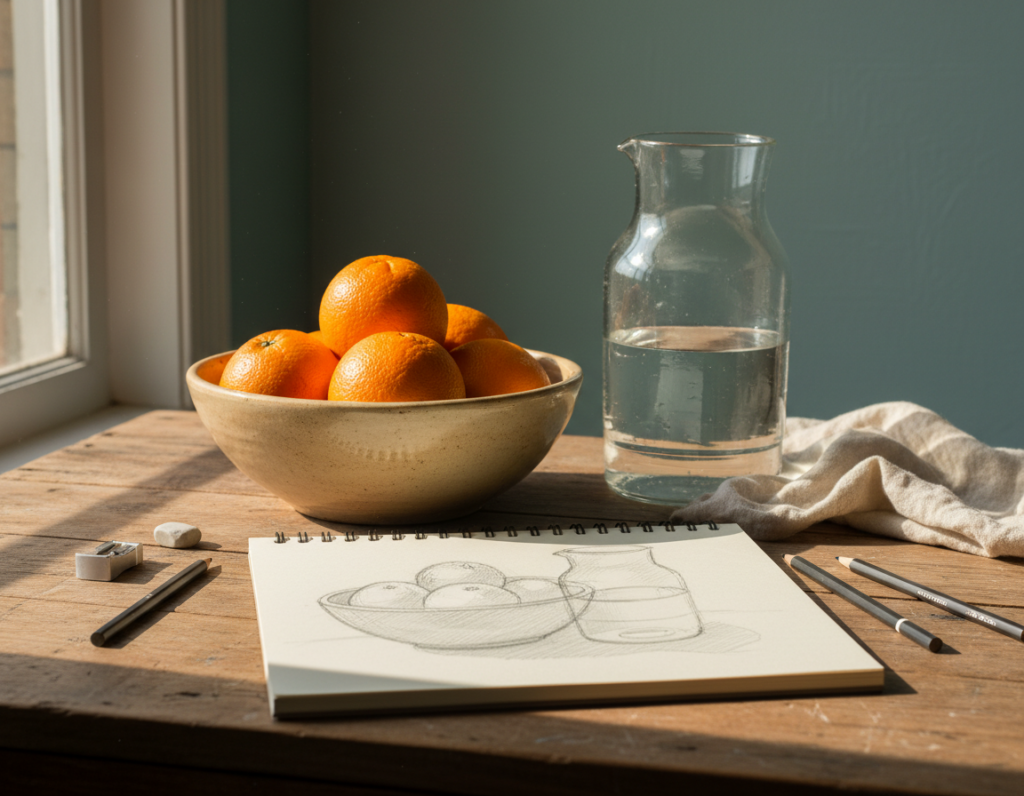
Identify the value components
Highlight — the brightest spot on a curved surface. Midtones — the area between light and dark. Core shadow — the darkest form area on the object.
Reflected light appears near edges facing the ground. Cast shadow anchors an object and gives real depth.
Make lights pop with darks
Commit to true darks in core and cast shadows. Use a 2B for midtones and a 6B to deepen blacks. Darker tones make lighter areas read as brighter and increase contrast.
Smooth shading and texture techniques
Shade with the side of the pencil for gradual transitions on eggs, fruit, and cylinders. Layer strokes rather than pressing hard to avoid waxy patches.
Cross-hatching gives controlled gradation on matte surfaces. Stippling works well for granular textures and when you want clean, even tone without smudging.
Transparent and reflective surfaces
For glass or metal, draw the value shapes you see: sharp reflections, bright highlights, and darker bands. Rely on value edges, not outlines, to describe form.
“Let value edges, not contour lines, define your forms.”
| Focus | Technique | Common mistake |
|---|---|---|
| Highlight & midtones | Side shading, layering | Muddy midtones from overblending |
| Core & cast shadows | Use softer dark pencil (6B) | Weak cast shadows that float the object |
| Textures & surfaces | Cross-hatch / stipple | Outlines that flatten form |
Practice tip: compare your drawings frequently to the setup. Check overall value relationships before adding small details to keep depth and form convincing.
Practice Prompts and Artist References to Grow Your Skills Over Time
Set a small, repeatable routine that focuses on observation and steady progress. Keep sessions short and clear so improvement shows in weeks, not months.
Daily prompt: three objects, one lamp, one page. Work timed studies at 2, 5, 10, and 20 minutes to refine proportion and speed.
Texture-focused studies and weekly rotations
Rotate subjects weekly to build a broad visual library. Try ceramics, cardboard, then reflective metal or glass.
Focus studies on textures: shells for ridges and highlights, insects for stippling and fine edge work, driftwood and rope for irregular contours, and worn shoes for layered value and materials.
Learn from artists and paintings without copying
Study Giorgio Morandi to see how restrained placement and subtle tones make simple vessels feel sculptural.
Look at Paul Cézanne’s paintings to learn how multiple forms balance and how cloth and planes organize a scene.
“Observe works closely: note composition, value choices, and how an artist treats edges.”
From Vincent van Gogh, study storytelling in ordinary subjects and strong value contrasts—use van Gogh as inspiration, not as a template.
Use video and a dated sketch log
Use pause-and-draw videos for measuring and shading demos. Repeat timed exercises from tutorials to build accuracy under pressure.
Keep a dated sketch log to track recurring problems—ellipses, perspective, or weak shadows—and tailor future practice to fix them.
| Practice Type | Goal | Example |
|---|---|---|
| Daily quick study | Observation & speed | 3 objects, 1 lamp, 2–20 min timed runs |
| Weekly rotation | Broaden subjects & techniques | Ceramics → cardboard → metal/glass |
| Texture focus | Surface detail & edge control | Shells, insects, driftwood, worn shoes |
| Artist study | Composition & value strategies | Morandi, Cézanne, van Gogh examples |
Conclusion
Summarize your process aloud: choose simple objects, set one controlled light, design a triangular composition, block in big shapes, measure carefully, fix eye level, then build values. Make one strong.
Compare each mark to the real setup as you go. Use measurement and value relationships instead of guessing. Re-check proportion or perspective before trying to “fix” with shading.
A single lamp matters because it clarifies shadow logic and reveals a full value range. Treat this routine as a repeatable practice: set up a small study today, finish a full-page drawing, and repeat.
These habits link still life and life drawing—consistent observation turns each subject into better work over time.