Anúncios
Capture the essence of a subject in short bursts. This guide shows how to use fast sketching to support visual thinking and record ideas when time is limited.
Speed is a learned skill. With repeatable methods and simple tools, anyone can build a habit that fits commutes, lunch breaks, and waiting rooms.
This section previews a clear workflow: select low‑decision tools, follow a pared‑down process, use gesture to imply movement, and apply fast value marks to define form.
Who this helps: busy creatives, urban sketchers, designers, students, and anyone who wants to record visual ideas without long setups.
The promise is practical. After short practice sessions you will finish more drawings per week, feel less daunted to start, and gain confidence with line, shape, and proportion under tight time limits.
Anúncios
Why Sketching Fast Helps You Capture the Essence of an Idea
Putting marks on paper quickly converts mental concepts into concrete, testable forms. Rapid drawing turns vague thoughts into visible options you can compare and improve.
How rapid marks boost thinking and creativity
Sketching helps you think on paper. Making simple shapes and notes forces choices that reduce overthinking.
More iterations mean better problem-solving. By producing multiple sketches, you test composition, proportion, and focal points fast. This fuels creativity and practical decisions in less time.
Anúncios
When speed matters most
You need fast marks when people shift pose, animals move, a bus leaves, or weather changes. Short sessions work well during commutes and busy work schedules.
Balance speed with accuracy
Quick does not mean sloppy. Aim for controlled simplicity: measure key points, use relative sizes, and keep proportion to build confidence. Accept small imperfections while keeping the drawing clear and intentional.
For gesture principles that help you capture energy, see gesture drawing.
Tools That Make Quick Sketching Easier (Without Decision Fatigue)
Small, reliable supplies make it easier to capture ideas when time and space are limited. Keep your kit focused so you spend energy drawing, not choosing.
Choose the right sketchbook and paper
Pick a pocket or A6 sketchbook. Smaller pages shorten the time per drawing and feel less intrusive in public.
Choose paper with enough weight and a smooth tooth so pens and markers don’t bleed or drag. Good paper speeds you up.
Fast mark-makers and their roles
- Main pen for commitment: a 1mm Uniball roller gives bold, confident ink quickly.
- Fineliner for edges: Staedtler 0.1–0.3 adds controlled lines and fine detail.
- Brush pen for expression: Tombow gray brush pens add thick-to-thin strokes and instant tone.
- Simple pencil option: one HB or 2B for light block-ins before you commit with pen.
Work in black and white, add simple tone
Training in monochrome removes color choices and sharpens your focus on line and value. Use gray markers or a brush pen to drop in midtones fast.
Gray values create depth without long hatching. For experimentation, try charcoal once in a while, but keep your core kit minimal to avoid decision fatigue.
| Item | Role | Example | Why it speeds you up |
|---|---|---|---|
| Pocket sketchbook | On-the-go canvas | A6, 100–160 gsm | Smaller page = faster finish |
| Main pen | Commitment lines | Uniball 1mm roller | Bold ink, instant confidence |
| Fineliner | Controlled edges | Staedtler 0.1–0.3 | Precise lines without fuss |
| Brush/marker | Tone and weight | Tombow gray brush pens | Fast midtones and expressive strokes |
Set Up Your Sketching Space for Speed Anywhere
Start with less to get more done. A tiny, reliable kit removes friction so you can practice every day without excuses.
Sketchbook + one main tool
Grab-and-go: one small sketchbook and a primary pen you trust. Add an optional gray marker for tone.
Keep the kit in a jacket pocket or bag. Pack a spare pen and use caps or a case that stops leaks.
Use a timer to protect your session
“Treat the timer as an appointment with yourself.”
Set short slots: 5 minutes trains big-shape decisions, 10–15 minutes lets you add essentials, and 30 minutes builds a fuller workflow. These time blocks teach you to commit to lines and move forward instead of fixing every mark.
- Why it works: fewer choices reduce decision fatigue.
- Timers make sketching a habit, not something you do “if I have time.”
- Short, daily practice builds speed and confidence in a sustainable way.
Quick Sketch Techniques: A Simple Step-by-Step Process You Can Repeat
Start each session with a short warm-up to loosen your hand and wake up your eye. Do 1–2 minutes of straight strokes, C-curves, circles, and free scribbles. These marks reduce stiffness and make later lines more confident.
Block in the big shapes
Map the composition fast. Use rectangles, cylinders, and triangles to place the main shapes. This organizes the page before any tempting detail appears.
Check proportion with key points
Measure top, bottom, left, and right landmarks and compare with a simple relative measure. Mark where major elements touch or overlap to keep the subject accurate.
Commit with fewer, stronger lines
Turn loose scaffolding into decisive lines that define form. Accept rough marks and avoid erasing too much; commitment keeps sketches lively and readable.
Finish with selective detail
Add only the elements that improve clarity: edges, overlaps, a facial feature, or a piece of signage. Skip repetitive textures and leave space for the viewer to fill in the rest.
This process is repeatable across objects, people, and scenes. Practice the same steps to build speed and consistency so each session feels productive.
Draw Faster by Simplifying What You See
Make your marks smaller to finish more drawings and train your eye faster.
Small studies beat long renders. Working in a reduced scale lets you repeat ideas more often. That repetition improves sketching and drawing skill faster than one polished piece.
Use a pocket sketchbook and light, reliable paper so you can draw anywhere. A tiny page shortens decision time and keeps sessions public‑friendly.
Prioritize big shapes and dominant angles
Start with the largest forms and major angles. Those elements carry recognition more than tiny details. Place broad shapes first, then check proportion with a single measuring line.
Suggest texture in selected areas
Imply surfaces with a few marks: a handful of bricks to suggest a wall, a few hair strokes to imply volume. Leave other areas quiet so the eye fills gaps.
Practice line economy and control erasing
Use fewer, stronger lines to describe form. One decisive line can replace a cluster of hesitant strokes.
Limit erasing: correct major proportional errors, but avoid fixing every small mark. Embrace imperfections; they speed momentum and shape a personal drawing style.
| Tip | Why it helps | How to apply |
|---|---|---|
| Small format | More repetitions per hour | Use a pocket sketchbook, 100–160 gsm paper |
| Big shapes first | Fast recognition of subject | Block in rectangles, ovals, dominant angles |
| Selective texture | Clarity without clutter | Mark a few bricks, hair strokes, or roof tiles |
| Line economy | Cleaner, readable sketches | Choose one confident line over many tentative ones |
Capture People, Movement, and Energy with Gesture and Flow
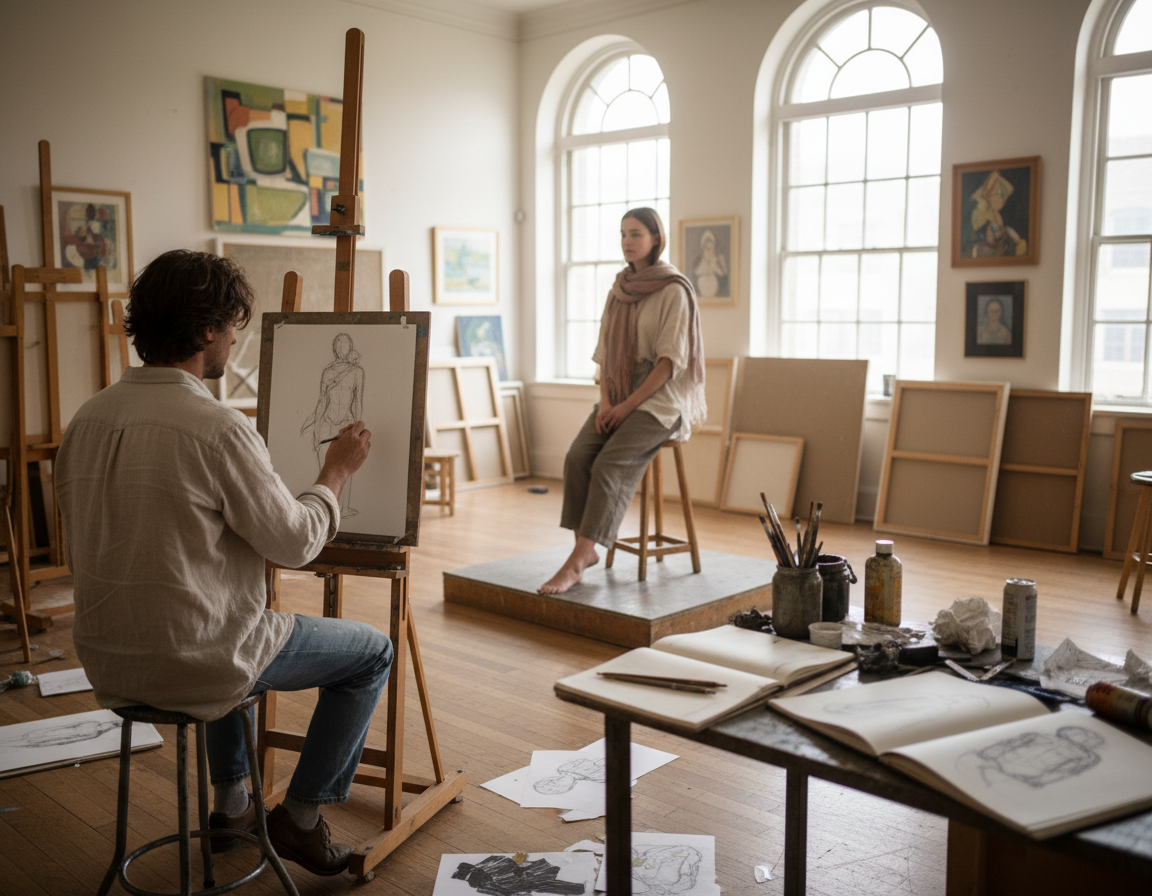
Catch the rhythm of a pose before it dissolves. Gesture drawing records action, weight, and rhythm first, not clothing or fine detail.

Gesture drawing to grab pose, action, and rhythm in seconds
Think seconds-first: work with 20–60 second gestures to see the whole pose as one flowing idea. This trains your eye to read movement and overall weight fast.
Using loose, fluid lines to record movement before it changes
Loose lines capture the sweep of a limb or the tilt of a torso. Use a single line of action, then suggest head, ribcage, and pelvis with quick shapes.
Quick strategies for sketching people in public without getting stuck
Draw smaller, pick seated subjects, and accept partial captures when the subject moves. Limit landmark shapes to stay fast and avoid overworking a single figure.
| Focus | Purpose | How to apply |
|---|---|---|
| Line of action | Show rhythm | Start with one flowing curve |
| Landmark shapes | Keep proportion | Mark head, ribcage, pelvis |
| Short durations | Train speed | 20–60 second gestures, repeat often |
Many artists develop shorthand for recurring subjects to stay lively and efficient. Treat each figure as one of many drawings, not the perfect piece, and your output and skills will grow.
For more on capturing motion and energy with gesture, see gesture drawing methods.
Add Depth Fast with Value, Tone, and Limited Color
Shade with two values for instant structure
Use paper white plus one dark value to define form quickly. This two-value approach simplifies decisions and makes buildings, objects, and figures read as three-dimensional.
Mass tone before outline
Block in shadows first. Use a soft pencil or gray brush pen to mass large dark shapes, then add a light outline only where it helps. This painterly technique often looks stronger than line-first work.
Fast hatching and cross-hatching in pen and ink
For pen-and-ink work, orient strokes consistently and vary spacing to suggest midtones and deep shadow. Build tonal areas with parallel lines, then add a second angled pass for cross-hatch where you need more weight.
Pencil versus pen for tonal planning
Start with a pencil when you want quick erasing and soft edges. Switch to pen when you need permanence and contrast. Both tools speed decisions when used for clear tonal blocks rather than overworked detail.
Limit color to stay cohesive
Pick a small palette—three colors or less—and stick to restrained accents. Gray markers or a single colored pen unify a page and often become a signature element of your art and personal style.
Time-Boxed Sketching Exercises to Build Speed and Skill
Timed drills force choices that sharpen observation and decision-making. Use a simple plan and a timer to make practice measurable and repeatable.
Five-minute drill: train shape recognition
Work only with the largest forms. Block in two or three dominant shapes and stop. This exercise strengthens your ability to capture essence under strict time limits.
Ten- to fifteen-minute session: essentials plus details
Spend the first third on composition, the middle on proportion checks, and the last on a couple of meaningful details. This is a great way to practice decisions without overworking the piece.
Twenty-minute exercise: accuracy without over-rendering
Use this slot to check landmarks and refine structure. Prioritize proportion and readable tone over finishing every small detail.
Thirty-minute study: workflow and confidence
Follow a repeatable process: study the reference for 20–60 seconds, mark key shapes, set the timer, then work in ordered stages. Ian Fennelly often uses 30 minutes to capture many strong details while omitting less important areas.
Track progress and make practice deliberate
Log date, time limit, subject, and one note on what improved. Repetition under constraints is the most reliable way to capture the essence of a scene and grow real skills.
Conclusion
Turn small, timed exercises into a reliable path toward stronger lines and clearer form. The core promise is simple: these quick sketch techniques help you capture ideas faster by trimming choices and following a repeatable process.
Keep a single sketchbook and a minimal kit—one pencil, one pen, and an optional gray marker. This setup avoids decision fatigue and keeps your sessions short and focused.
Warm up the hand, block in big shapes, check proportion, commit confident lines, and add selective details. Regular time-boxed practice builds speed and makes drawings more intentional.
Apply the method to people, objects, and scenes. Try ink, pencil, or charcoal, but stay consistent with a primary setup. Prioritize clarity and energy over perfect rendering, and let repeated sketches grow your confidence, creativity, and personal style.