Anúncios
This short guide shows how to build keen observation skills through simple, repeatable sketching sessions. The goal is clear: learn to see relationships in form, proportion, perspective, edges, and value so your work feels believable.
Representational art depends on looking at the subject, not guessing from memory. Many great artists use references and models; no-reference myths slow progress. Working from life gives richer cues—shifting light, texture, and context—than photos alone.
Expect steady gains from short, regular sessions rather than occasional marathons. This approach fits busy students and self-taught artists. The article maps a clear path: foundation → routine → core observation mechanics → life vs photo → proportions → perspective → tone and texture → drills and review.
Exercises are practical and measurable. You will learn what to look for, how to check relationships, and how to correct them while you sketch. A focused course of small habits, not talent, builds reliable drawing skills over time.
Why Observation Is the Real Foundation of Drawing Skills
True skill starts when your eyes map relationships, not when your mind names objects.
Anúncios
Looking often means quick labels: “eye,” “leaf,” “cup.” That habit leads to generic symbols in your sketches. By contrast, seeing means tracking angles, relative sizes, alignments, and subtle value shifts so the hand has clear instructions.
“Seeing is the act of unwavering attention; it turns everyday looking into a meditative awareness.”
How active observation improves outcomes
Observation is not passive. It is comparing relationships: which line tilts, which shape is wider, how edges meet. This process reduces proportion errors and gives paintings and drawings believable form and light.
Anúncios
Clearing up the “no reference” myth
Using a reference is normal. Artists and artists throughout history worked from models, painted on location, and used aids. The tested skill is accuracy of seeing and translating, not memorizing shapes.
| Mode | What you do | Result |
|---|---|---|
| Looking | Label objects quickly | Symbolic, generic marks |
| Seeing | Measure angles, sizes, values | Accurate, believable drawings |
| Habit shift | Scan subject and paper often | Fewer proportion errors; stronger composition |
Next step: Build a short routine so this way of seeing becomes automatic and reliable.
Set Up Your Sketching Routine for Fast, Noticeable Progress
A small, consistent sketch routine is the quickest route to clearer proportion and steadier marks.
Simple materials that support accuracy:
Choose one reliable pencil and plain paper. Keep a clean page layout with margins for measuring marks and corrections.
Fewer tools means fewer decisions. That keeps attention on measuring angles, sizes, and alignments instead of on gear.
How to pick the right subject
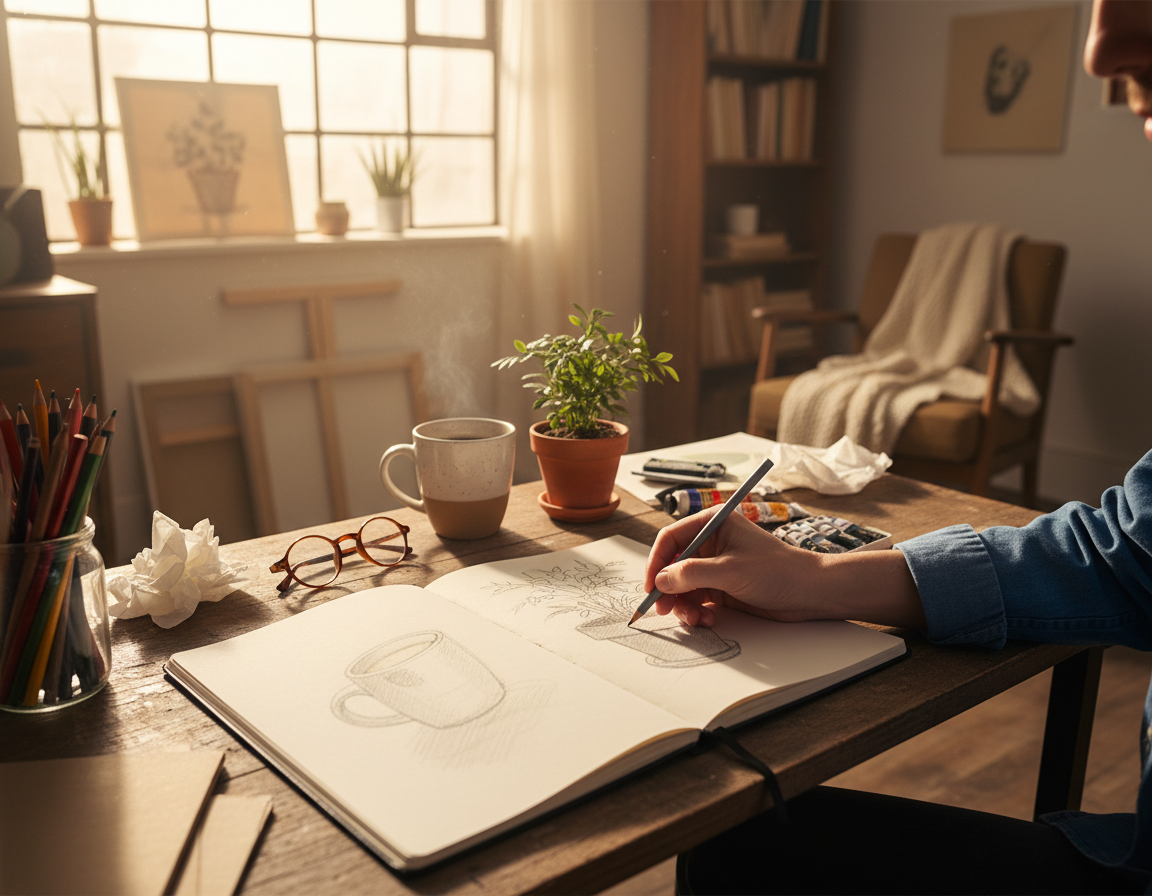
Start with stable, simple objects: a mug, a book, or a piece of fruit. These let you focus on major forms before adding details.
Life subjects give richer cues—light shifts, texture, and subtle angles—so try them when you can. Use a photo only when the object can’t stay still.
A routine template that works:
- 15–30 minute sessions
- 3–5 days per week
- Track a week-to-week sketch log to notice progress
Control the setup: fix the viewpoint, keep steady lighting, and use a stable surface so the subject doesn’t move while you measure.
“Confirm the overall size and placement before you add details—this single habit prevents floating, off-center sketches.”
Scale difficulty slowly: add one new challenge at a time—another object, a reflective surface, or a tricky angle. Small steps keep momentum and reduce frustration.
Observational drawing practice: Train Your Eyes to Outwork Your Hand
Train your eyes to lead each mark so the hand follows fresh facts, not guesswork.
The core habit is simple: keep your gaze moving—paper to subject to paper—so every line gets checked against real sight.
The “eyes constantly dance” habit
Look longer than you draw. Scan the subject, then make a careful, short mark. Return to verify.
Measuring relationships
Compare heights and widths, check key angles, and align parts against one another. Use a straight arm or pencil to gauge angles and transfer them to the page.
Drawing what’s there, not what you think
When your brain supplies a familiar shape, stop and ask: What is the actual angle or curve I see right now? This question breaks the habit of symbol marks.
Use all available information
Life gives moving light, shifting textures, and context. Note cast shadows, surface change, and even sound or smell that steady your attention.
- Mini flow: 2 minutes scanning and measuring.
- 5 minutes block-in; then check-and-correct cycles.
- Slow the hand; let the eye collect information before committing lines.
| Focus | What to do | Quick result |
|---|---|---|
| Scan | Paper → subject → paper | Fewer memory errors |
| Measure | Compare widths, heights, angles | Tighter proportions |
| Verify | Ask “What do I actually see?” | More truthful drawings |
“Let the eye set the rules; the hand only follows verified information.”
Draw From Life First, Use Photographs Strategically
Working from life gives you changing light and real depth cues that photos can’t fully replicate.
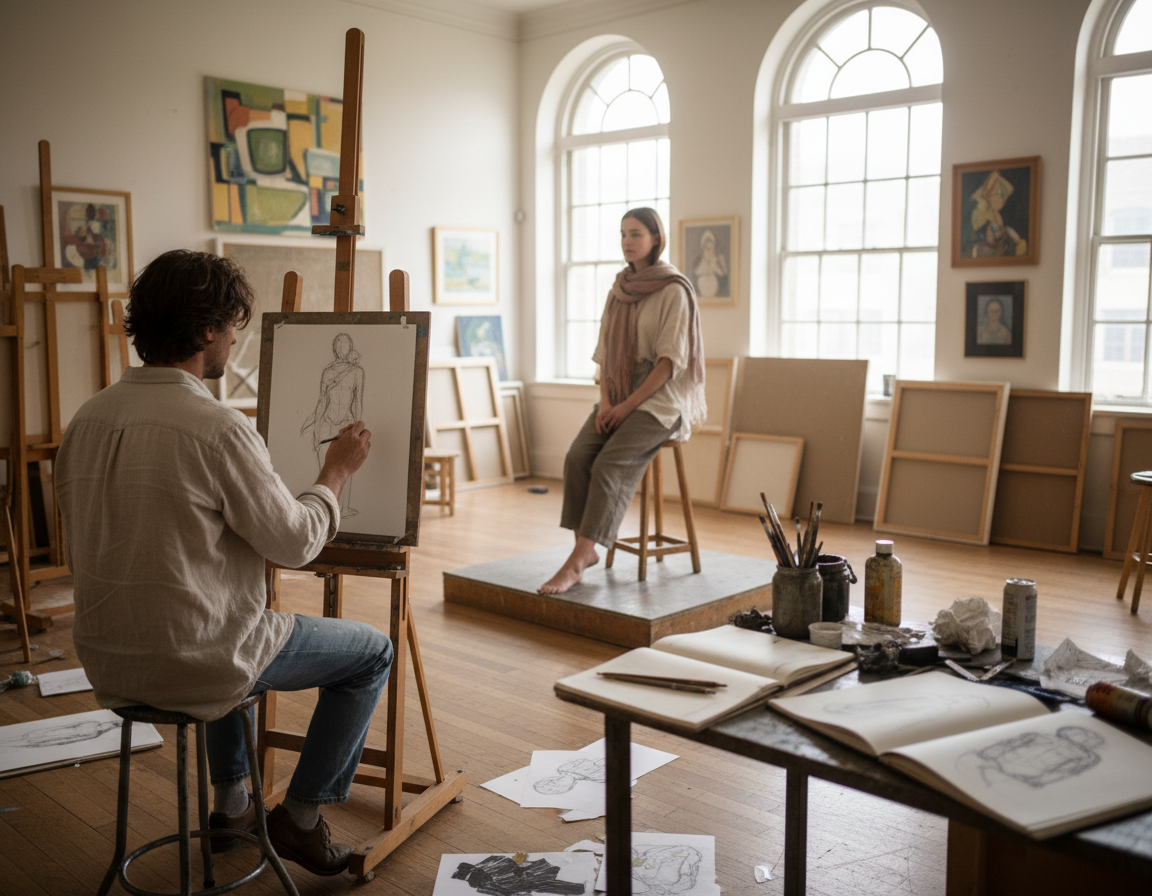
Life study supplies a wealth of sensory information. Over a short time, light shifts, textures reveal themselves, and nearby objects add context. Those cues train your eye to read form and space for better painting and drawing skills.
Why real subjects matter
Real objects show subtle edge shifts and depth that a flat photograph hides. Seeing a subject in person helps you sense scale, temperature of light, and surface quality. This speeds visual learning.
When to use photographs
Use a photograph when you can’t access a subject—complex setups, distant scenes, or staged figure work. Take a high-quality reference with clear lighting and little distortion.
Blend life and photo for stronger results
Start with in-person observational drawing to lock proportions and form. Then photograph your setup to finish values or details later. Draw the subject from two angles to force new measurements and stop copying remembered outlines.
“Use photos to support what you saw, not to replace the act of seeing.”
Avoid Tracing and Build Real Skill Instead
Tracing skips the eye’s work and hands you a copy, not a skill.
For learners, the core problem is simple: tracing removes measurement. Instead of checking angles, sizes, and alignments, you copy an edge. That substitution stalls real skill growth for students and artists.
Why traced outlines often feel wrong
Traced results can be technically accurate but look flat. Outlines become heavy and graphic. Real objects reveal edges by changes in tone, not by dark border lines.
When tracing can be useful
- Transferring your own sketch to a final sheet.
- Creating repeat patterns or clean layouts.
- Preparing compositional guides for complex work.
These uses serve production goals, not the goal of building observational skills.
Alternatives that train the eye
Use light block-ins, comparative measurement with a pencil, and frequent alignment checks. Repeat small studies and show process for assessments and portfolios.
“Show the steps you took—studies, corrections, and checks—to prove the work is earned.”
| Issue | Tracing result | Observation method |
|---|---|---|
| Measurement | Skipped | Comparative pencil measuring |
| Edges | Graphic outlines | Define by tone shifts |
| Skill transfer | Limited to one image | Applies across subjects |
Lock In Accurate Proportions Before You Add Details
First find where the big shapes live; that prevents parts from drifting off the paper. Start light and rough. Treat the page as a map before you place any details.
Blocking major shapes to stop “floating” work
Block in the largest forms first. Lay out overall height and width, then set the main overlaps and contact points. This anchors the object and avoids floating sketches that don’t touch the ground or frame.
Use guidelines and comparative measuring
Use center lines, bounding boxes, and angle guidelines to lock placement and scale. Hold a pencil at arm’s length to compare lengths and check negative shapes between parts.
Grid method for photo reference: pros and cautions
The grid boosts accuracy for a photograph reference by letting you focus on one square at a time. It can also stiffen results if you stop checking big relationships.
Keep the grid light. Fade it as you go, prioritize major value shapes, and re-check the whole form so the work stays alive.
Ellipses made simple
On cylinders, draw rounded ellipses at the ends. Pointed ends usually mean you guessed the curve. Keep ellipses shallow or full depending on the angle, not jagged.
| Step | What to do | Quick benefit |
|---|---|---|
| Block-in | Place largest shapes; set height/width on paper | Prevents floating parts; easier detail placement |
| Measure | Use pencil comparisons; check negative shapes | Improves scale and alignment |
| Grid | Apply to photograph reference; focus square-by-square | Higher accuracy; risk of stiffness if overused |
| Ellipses | Draw rounded ends on cylinders | Believable form for cups, bottles, and tubes |
“Secure proportions first; details come easily when the framework is right.”
Make Space Look Real With Perspective and Form
Treat the page as a window into the scene. When the basic perspective is correct, the whole image reads as real. Many sketches feel wrong because scale shifts or angles don’t follow a common set of vanishing points.
Why perspective fixes the “something feels off” problem
Even strong shading can’t hide mismatched scale or misaligned edges. Perspective sets where parallel lines converge so objects shrink naturally with distance.
Simple perspective basics you can use now
Find the horizon (eye level) first. Place one or two vanishing points for boxes and interiors. Draw light guide lines to show how parallel edges converge.
Depth cues beyond vanishing points
- Size change: objects farther away appear smaller.
- Overlap: use overlapping shapes to show what sits in front.
- Edge relationships: check how planes meet so forms read in space.
Apply this to common objects—books, tables, boxes—and your form will sit correctly. When major forms read in perspective, later tone and texture follow without fighting structure.
“Identify the dominant direction lines and confirm they all agree on convergence—this quick check removes subtle distortions.”
For a focused tutorial on one-point setups, see one-point perspective to practice aligning lines and building believable space.
Render What You See: Edges, Tone, and Texture Without Over-Outlining
Start by letting tone, not lines, define the edge between forms. Keep outlines light in the block-in stage and let contrast reveal where one plane ends and the next begins.
Build a full value range by finding the whitest white and the deepest darks you actually see. Place those two anchors first, then fill mid-tones so the piece reads as form, not a silhouette.
Avoid automatic shading habits. Instead of shading everything, locate true shadow shapes and core shadows, then render them with controlled mark-making. This step stops random smudges from flattening the work.
- Mark-making menu: use hatching and directional lines for planes, dots for granular textures, and smudges sparingly for soft transitions.
- Focus with edges: sharpen contrast where you want attention; soften edges where forms recede.
Light logic is simple: highlights sit where light hits directly, cast shadows follow the object’s relation to the surface, and core shadows show the turn of a form. If a sketch looks outlined or flat, reduce line weight and rebuild with tone relationships.
“Let value, not contour, do the work—your pencil and paper will thank you.”
Strengthen Attention With Observation Drills and “Seeing/Drawing” Practice
Short, focused drills sharpen the kind of attention that makes accurate marks easier. These exercises take little time but train students to notice subtle lines and shapes before they sketch.
Quick no-drawing matching drill
Lay out several similar doodles and spend one minute scanning them. Pick the closest match without drawing.
Write down specific line and shape differences you saw: a kink in a curve, a slightly longer angle, or a gap in spacing. This trains visual discrimination and reduces guessing.
Non-objective doodle copying
Copy a doodle that does not represent a real thing. Because the brain can’t rely on symbols, you must copy pure relationships of lines, angles, and spacing.
This lesson breaks symbol habits and tightens measurement skills.
Seeing/drawing as meditation (20 minutes)
Try Frederick Franck’s method: close your eyes briefly, then look intently. Hold the pencil loosely and let your hand follow the contour your eye tracks. Don’t look down at the paper.
Commit to twenty minutes, pick a simple subject, and avoid judging results. Success is sustained attention, not a polished sketch.
Review to improve next time
After each session, compare your sketch to the subject. Note specific errors—angle shifts, proportion drift, misplaced edges, or wrong shadow shapes.
Convert that note into one clear goal for the next session, for example: check alignments every 30 seconds or block in big shapes before details. Rotate these exercises across the week so the attention work directly boosts your drawing skills.
“Measure what you missed; make that miss the lesson for your next sketch.”
Conclusion
A steady habit of looking, measuring, and correcting turns guesses into facts.
Keep sketching in short, regular sessions so your eye learns relationships faster than the hand adapts.
Start each sketch by blocking in proportions, confirm perspective and major form, then render with tone and soft edges rather than heavy outlines.
Draw from life first for richer cues; use photos to support what you saw, not to replace observation.
Use quick drills to sharpen attention and reduce symbol marks—this accelerates skill gains across every session.
Next step: pick one simple subject, schedule three brief sessions this week, and note fewer proportion errors and more believable form.
Keep accuracy and expression together: measured seeing and personal mark-making make stronger, more honest art.