Anúncios
Picking a base for your work impacts the final result quite a bit. Many artists forget how the surface feel changes their lead or ink. Finding the best art paper remains essential for every student in the United States.
This guide explores several options to help you pick the best match for your tools. Whether you like smooth sheets or rough textures, knowing the variety available today changes everything. Good quality leaves provide a strong start for your creative growth.
Quality materials ensure your sketches last for years without fading. Selecting a premium medium allows your creativity to shine through every stroke you make. Every mark on these illustration surfaces tells a story of passion and skill.
Artists must consider weight and tooth when browsing for supplies at local shops or online retailers. The right choice often depends on whether you use charcoal, pencils, or pens. Thick sheets prevent bleeding, while thinner options work well for quick practice sessions.
Investing time in learning about these surfaces elevates your craft to new heights.
Anúncios
What Makes Drawing Paper Unique
Unlike ordinary paper, drawing paper is designed with specific attributes that enhance the artistic process. The uniqueness of drawing paper lies in its ability to withstand various artistic techniques without compromising the quality of the artwork.
One of the primary characteristics that make drawing paper stand out is its durability. Drawing paper is designed to be robust, handling multiple layers of media, erasures, and corrections without tearing or buckling. This resilience is crucial for artists who work with a variety of mediums, from pencils and charcoal to ink and watercolors.
The texture of drawing paper is another significant factor that contributes to its uniqueness. The texture, or “tooth,” of the paper affects how different drawing tools interact with its surface. Papers can range from smooth to very textured, catering to different artistic preferences and techniques.
Anúncios
The weight of the paper is also a critical characteristic. Heavier papers are more durable and less prone to buckling when exposed to wet media or heavy drawing. The weight is usually measured in grams per square meter (GSM), with higher GSM indicating heavier, more robust paper.
In summary, the unique characteristics of drawing paper, including its durability, texture, and weight, make it an indispensable tool for artists. By understanding these attributes, artists can choose the most suitable paper for their specific needs, enhancing their overall creative experience.
Understanding Paper Weight and GSM
The weight of drawing paper, often expressed in GSM, is a fundamental characteristic that influences its performance with various artistic techniques. GSM stands for Grams per Square Meter, a standard measure that indicates the density and durability of paper.
Paper weight is crucial because it affects how the paper handles different drawing mediums. Heavier papers are generally more durable and less prone to buckling or warping when exposed to wet media or heavy pencil work.
What Paper Weight Means for Your Art
The weight of your drawing paper can significantly impact your artistic process. Lighter weights (around 80-100 GSM) are suitable for quick sketches and everyday drawing where you don’t plan to use a lot of wet media. However, for more detailed work or when using mediums like watercolor or ink, heavier papers (at least 200 GSM) are preferable.
Choosing the right paper weight ensures that your artwork looks its best and that the paper can withstand your creative process. For instance, very heavy papers (above 300 GSM) are ideal for professional art pieces that require durability and resistance to wear.
Standard Weight Categories Explained
Drawing papers come in various weights, categorized based on their GSM. Here’s a breakdown of standard weight categories:
| GSM Range | Description | Suitable Uses |
|---|---|---|
| 80-100 GSM | Lightweight | Quick sketches, everyday drawing |
| 150-200 GSM | Medium weight | General drawing, light watercolor |
| 300 GSM and above | Heavyweight | Professional art, heavy watercolor, mixed media |
Understanding these categories helps artists select the appropriate paper for their work, ensuring the best possible outcome.
Paper Texture and Tooth: Why It Matters
The surface quality of drawing paper, referred to as its texture and tooth, plays a vital role in artistic creation. The texture and tooth of paper are critical factors that can significantly affect the outcome of a drawing.
The choice of paper texture and tooth is not just a matter of personal preference; it is a deliberate decision that can enhance or detract from the artwork. For instance, a paper with a lot of tooth can produce rich, textured strokes with charcoal or pastels, while a smoother paper might be better suited for detailed pencil work.
Understanding the different types of paper texture is essential for artists. The main categories are hot-pressed, cold-pressed, and rough surface papers, each with its unique characteristics and applications.
Hot-Pressed Paper Characteristics
Hot-pressed paper is known for its smooth surface. It is ideal for detailed work and techniques that require precision, such as fine pencil drawings or pen and ink illustrations. The smooth surface allows for sharp lines and detailed renderings.
Cold-Pressed Paper Properties
Cold-pressed paper has a moderate texture, offering a balance between smoothness and tooth. It is versatile and can be used with a variety of mediums, including watercolor, ink, and mixed media. This texture is particularly favored for its ability to handle multiple layers of media without buckling.
Rough Surface Paper Features
Rough surface paper has a pronounced texture and a lot of tooth, making it perfect for expressive and textured artworks. It is often used with mediums like charcoal, pastels, and watercolor, where the texture of the paper can add an extra layer of interest to the artwork.
| Paper Type | Texture | Tooth | Best Used For |
|---|---|---|---|
| Hot-Pressed | Smooth | Low | Detailed pencil work, pen and ink |
| Cold-Pressed | Moderate | Medium | Watercolor, ink, mixed media |
| Rough Surface | Rough | High | Charcoal, pastels, expressive artworks |
By understanding the characteristics of each paper type, artists can make informed decisions about which paper to use for their work, ensuring that the texture and tooth of the paper enhance their artistic vision.
Common Drawing Paper Types and Their Uses
When it comes to drawing, the type of paper used can significantly impact the outcome, with various papers suited to different techniques and mediums. The right paper can enhance the artistic process, providing the desired texture, durability, and overall performance.
Sketch Paper for Everyday Drawing
Sketch paper is a versatile and widely used type of drawing paper, ideal for everyday sketching and drawing. It is typically available in a range of weights and textures, making it suitable for a variety of mediums, from pencils and pens to markers.
Sketch paper is often preferred for its affordability and accessibility, allowing artists to practice and experiment without incurring significant costs. It is also commonly used for quick sketches and studies, as well as for developing initial ideas and concepts.
Bristol Board for Detailed Work
Bristol board is a high-quality paper known for its smooth finish and durability, making it an excellent choice for detailed work and precise drawings. It is often used for technical drawing, illustration, and other applications where fine details are crucial.
Bristol board is available in different weights and can be either vellum or plate finish. The smooth surface allows for crisp, sharp lines and detailed renderings, making it a favorite among artists who require precision in their work.
Charcoal Paper for Bold Strokes
Charcoal paper is designed specifically for use with charcoal and other dry media, offering a unique texture that enhances the expressive qualities of these mediums. The paper’s toothy surface allows charcoal to adhere well, creating rich, bold strokes and subtle transitions.
Charcoal paper is often used for gestural drawings and expressive sketches, where the artist seeks to capture the essence and movement of the subject. Its texture and durability make it an ideal choice for artists working with charcoal, pastels, or other dry media.
Newsprint for Practice Sessions
Newsprint is a inexpensive, lightweight paper commonly used for practice sessions, sketching, and quick studies. While not as durable as other types of paper, newsprint is ideal for artists looking to practice and experiment without wasting more expensive paper.
Newsprint is also used for creating gesture drawings and capturing fleeting moments, as its ephemeral nature encourages spontaneity and freedom. Many artists use newsprint for warm-up exercises and preliminary sketches before moving to more refined papers.
| Paper Type | Best For | Characteristics |
|---|---|---|
| Sketch Paper | Everyday drawing, quick sketches | Versatile, affordable, various weights and textures |
| Bristol Board | Detailed work, technical drawing | Smooth finish, durable, precise lines |
| Charcoal Paper | Charcoal and dry media, expressive drawings | Toothy surface, enhances bold strokes and transitions |
| Newsprint | Practice sessions, gesture drawings | Inexpensive, lightweight, encourages spontaneity |
Specialized Paper for Different Media
The right paper can elevate an artist’s work, and different media require unique paper characteristics. Artists often need paper that is specifically designed to bring out the best in their chosen medium, whether it’s watercolor, pastel, markers, or a combination of various media.
Choosing the right paper is crucial for achieving the desired effects and ensuring that the artwork lasts over time. Different media have distinct requirements in terms of paper texture, weight, and durability.
Watercolor Paper for Wet Media
Watercolor paper is designed to withstand multiple layers of wet media without buckling or disintegrating. It is typically made from cotton or a high percentage of cotton, which gives it strength and durability when wet.
Key characteristics of watercolor paper include its weight (usually 140lb or 300gsm), texture (hot-pressed, cold-pressed, or rough), and sizing (the treatment that controls absorbency).
Pastel Paper Characteristics
Pastel paper is designed to have a texture that allows pastel particles to adhere well. It usually has a gentle “tooth” or grain that helps to hold the pastel in place.
The texture and tooth of pastel paper can vary, with some papers having a more pronounced texture than others. This variation allows artists to achieve different effects, from smooth, detailed work to more textured, expressive pieces.
Marker Paper and Bleed-Proof Options
Marker paper is designed to minimize bleed-through and feathering, ensuring that vibrant colors remain sharp and defined.
Bleed-proof paper is particularly useful for illustrators and graphic designers who work with markers or other fluid media. It allows for crisp, clean lines and prevents the ink from spreading unevenly.
Mixed Media Paper Versatility
Mixed media paper is designed to handle a variety of different media, from paints and inks to pastels and collage elements.
This type of paper is versatile and durable, capable of withstanding multiple layers and techniques without compromising its integrity. It’s ideal for artists who like to experiment with different materials and techniques in a single piece.
Toned and Colored Drawing Papers
The use of toned and colored papers in drawing can significantly enhance the overall aesthetic of an artwork. Toned papers, in particular, have gained popularity among artists for their ability to add depth and emotion to a piece.
Toned paper provides a mid-tone base that can dramatically influence the overall mood of a drawing. By starting with a toned surface, artists can create contrast and highlight areas more effectively.
Benefits of Working on Toned Paper
Working on toned paper offers several benefits. It allows for greater contrast between light and dark areas, as the toned background serves as a middle ground. This can make highlights appear more vibrant and shadows more profound.
- Enhances contrast and visual impact
- Provides a unique, pre-existing tone that can unify the artwork
- Can reduce the need for extensive shading or coloring
Toned paper is particularly useful for creating portraits and figure drawings, where subtle transitions between tones are crucial.
Popular Color Choices and Their Effects
The choice of color for toned paper can significantly affect the final artwork. Different colors evoke different emotions and can steer the viewer’s perception.
| Color | Effect |
|---|---|
| Gray | Neutral, ideal for realistic drawings |
| Brown | Warm, often used for traditional or vintage effects |
| Blue | Cool, can create a calming or melancholic atmosphere |
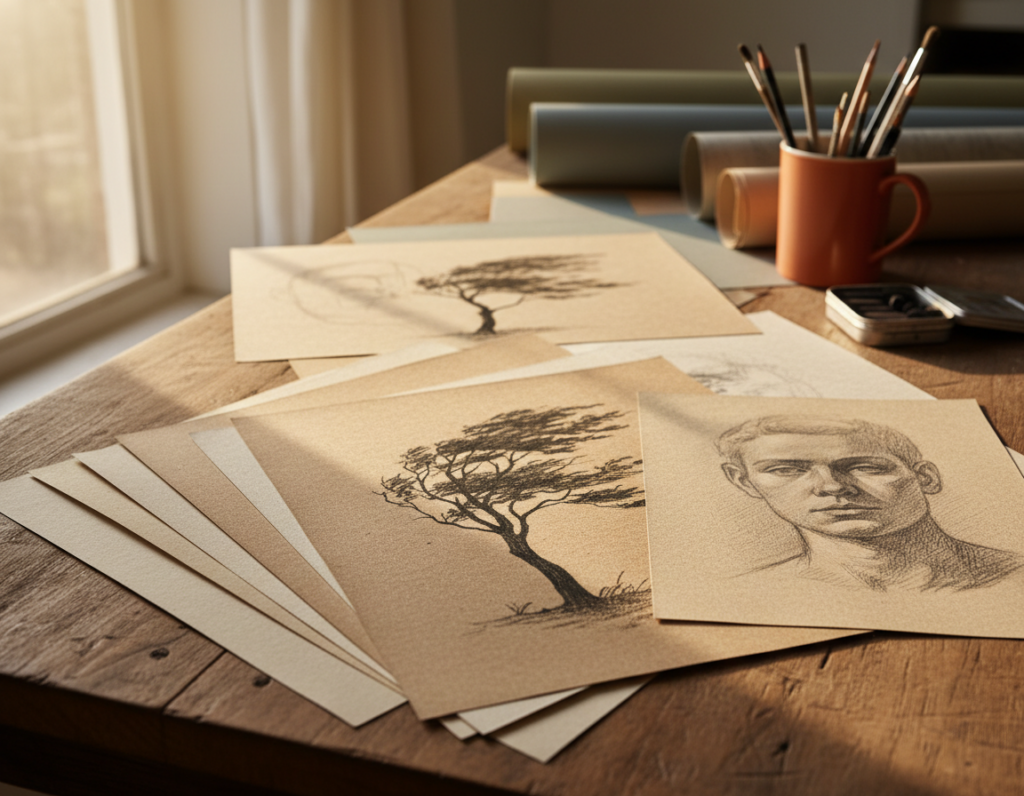
Artists often experiment with different toned papers to discover how various colors influence their work. By understanding the effects of different toned papers, artists can make informed decisions about their choice of paper.
Choosing the Right Drawing Paper Types for Your Project
Choosing the correct type of drawing paper is essential for achieving your desired artistic results. The right paper can enhance your drawing experience and the final outcome of your artwork.
Matching Paper to Drawing Medium
Different drawing mediums require specific types of paper. For instance, watercolor paper is designed to handle wet media without buckling or tearing. On the other hand, marker paper is often bleed-proof to prevent ink from seeping through. To learn more about the various types of art paper and their uses, you can refer to this beginner’s guide to art paper.
Here’s a brief overview of paper types suited for different mediums:
| Drawing Medium | Recommended Paper Type |
|---|---|
| Pencils, Pens | Sketch paper, Bristol board |
| Watercolors | Watercolor paper |
| Markers | Marker paper, bleed-proof paper |
| Charcoal, Pastels | Charcoal paper, pastel paper |
Considering Your Skill Level
Your skill level as an artist also plays a significant role in choosing the right drawing paper. Beginners might prefer more forgiving papers like sketch paper, while professionals might opt for high-quality, specialized papers that offer specific textures and durability.
Budget Considerations
Budget is another crucial factor when selecting drawing paper. While high-quality paper can be more expensive, it’s not always necessary for beginners or for practice sessions. Newsprint is a cost-effective option for sketching and practicing.
Ultimately, the best drawing paper for your project is one that balances your medium, skill level, and budget. By considering these factors, you can make an informed decision that enhances your artistic work.
Common Mistakes When Selecting Drawing Paper
Understanding the characteristics of different drawing papers is essential to avoid common pitfalls in artistic creation. Selecting the right drawing paper can be overwhelming due to the numerous options available, but being aware of frequent mistakes can guide artists in making informed decisions.
Using the Wrong Paper for Your Medium
One of the most common mistakes artists make is using paper that is not suitable for their chosen medium. For instance, using a paper that is too thin or not designed for wet media can lead to buckling or bleeding. Watercolor paper, for example, is designed to handle multiple layers of wet media without compromising its integrity.
To avoid this, it’s crucial to match the paper type to the drawing medium. For example, charcoal paper is designed to handle the abrasive nature of charcoal, while marker paper is often bleed-proof to prevent ink from seeping through.
Ignoring Acid-Free Properties
Another critical error is neglecting to check if the paper is acid-free. Acidic papers can degrade over time, causing the artwork to yellow or become brittle. This is particularly important for artists who intend for their work to last.
Using acid-free paper ensures that the artwork remains vibrant and intact for years to come. It’s a simple yet crucial consideration that can significantly impact the longevity of the artwork.
Overlooking Paper Grain Direction
The paper grain direction is another factor often overlooked by artists. The grain direction refers to the orientation of the paper fibers, which can affect how the paper behaves when used with different media.
For example, drawing with the grain can produce smoother lines, while drawing against the grain can create more texture. Understanding the grain direction is particularly important when working with media that require specific paper characteristics, such as watercolor or pastel.
Conclusion
Understanding the various types of drawing paper is crucial for artists to achieve their desired outcomes. This guide has provided a comprehensive overview of the different drawing paper types, their characteristics, and uses. By considering factors such as paper weight, texture, and color, artists can make informed decisions when selecting the ideal paper for their work.
A effective conclusion to this guide is to encourage artists to experiment with different drawing papers to discover what works best for their unique style and medium. By doing so, they can unlock new creative possibilities and enhance their artistic expression.
In summary, this drawing paper types summary has highlighted the importance of choosing the right paper for artistic success. With this knowledge, artists can confidently select the perfect paper to bring their creative visions to life.